
The story of State revenue collections in September was relatively simple: business tax revenues were remarkably strong, and every other revenue source was approximately on target.
The reality was somewhat more complex. Combined General and Education Trust Funds revenues from Liquor Commission profits were $1.7 million (14.8%) below target for the month, and Motor Fuels Tax revenue continued to slip behind. Interest earnings on State cash holdings declined again relative to the prior year (with the gap growing by $4.2 million in September), and the fact that Real Estate Transfer Tax revenues were on target was a change from the robust performance from earlier in State Fiscal Year (SFY) 2027. The State’s newest major revenue source, Video Lottery Terminals, continues to lag behind its target.
But these differences were small relative to September’s overall receipts. For the month, State revenues generated a cash surplus of $69.1 million for the combined collections of the General Fund and the Education Trust Fund, exceeding the planned amounts by 21.0%. This surplus was generated by combined Business Profits Tax (BPT) and Business Enterprise Tax (BET) receipts climbing much higher than expected; total BPT and BET revenues were $69.4 million (34.6%) above the amount forecast by the State Revenue Plan, and $94.7 million (54.1%) above the prior year.
How Important is This Single Month of Revenue?
State revenue changes from month to month should be interpreted carefully. Like other economic data, one month does not always indicate a new trend. For the majority of months in the year, a large swing in revenue from the two combined primary business taxes may not substantially affect State finances.
However, September is an important month for the business taxes. Most business tax revenue is paid through quarterly estimate tax payments, which businesses make every three or four months during their tax year, reflecting their projected tax liability based on the activity of the prior quarter. As the State reports that about 90% of businesses have a tax year that matches the calendar year, the months of June, September, December, and then March and April combined are key months for State revenue overall due to quarterly business tax payments.
As a result, overperformance of this magnitude in an important month for business taxes does meaningfully move the needle on total General and Education Trust Funds revenues. The $69.1 million surplus generated in September alone is larger than the $64.7 million surplus in the preliminary figures for all of SFY 2026 when the one-time Tax Amnesty Program is not included. As of the end of August, combined business tax revenues, which incorporate the State’s largest (BPT) and fifth-largest (BET) tax revenue sources, were $6.4 million (11.7%) below planned amounts for SFY 2027 thus far, but September’s totals reversed them to being $63.0 million (24.7%) ahead of the State Revenue Plan for the year thus far.
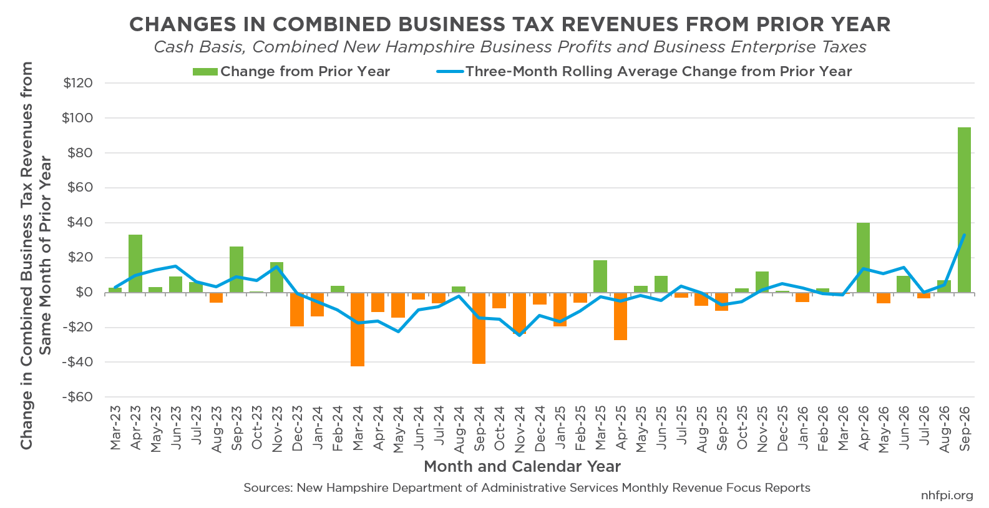
In total, the combined General and Education Trust Funds surplus grew from $5.8 million (2.1%) to $74.9 million (12.5%) solely because of September receipts. As discussions over a new State Budget unfold and amid uncertain trends in business tax receipts since SFY 2024, more positive results from business taxes could change the trajectory of available funding for the next State Budget.
What Caused the Upswing in Revenue, and Will It Continue?
The available information cannot result in conclusions about the causes of the increase in business tax revenues because the available information is too limited. The New Hampshire Department of Revenue Administration (DRA) typically does not receive substantive explanatory information from individual taxpayers regarding why payments change when they submit quarterly estimate payments. Quarterly estimate payments accounted for about 85.6% of all business tax receipts in September SFY 2027, according to the DRA.
A few factors may have contributed to this particular rise in September.
Refunds Continue to Decline
Businesses that overpay their taxes may request refunds from the State, which lower the net revenue the State receives from business taxes.
Refunds increased substantially, starting in 2023, in part due to State policy changes. Starting in Tax Year 2022, State policymakers capped the amount of money a business taxpayer can hold, or carryforward, as credit with the State to 500% of its liability, with the rest required to be refunded; that carryforward cap will drop to 450% of tax liability in Tax Year 2029 under current law and decline every two years after that until it reaches 150% in 2041.
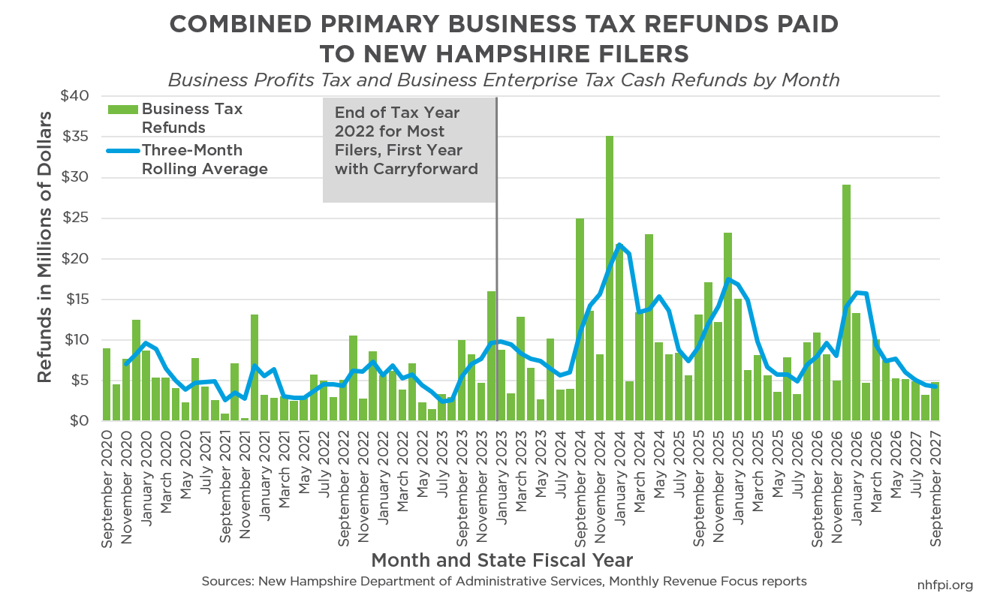
The cap appeared to increase the number of refunds requested, as businesses that otherwise might have stored their money with the State, which pays interest for the cash held from overpayments, were required to shift their dollars elsewhere. That cap likely had the greatest impact in SFYs 2023 and 2024. Business tax refunds in September SFY 2027 totaled $4.8 million, down from $10.9 million in SFY 2026, $13.1 million in SFY 2025, and $25.0 million in SFY 2024.
Businesses Did Not Forecast Profit Growth Earlier in the Year
Uncertainty about the economy, including job growth, trade policy, and energy prices, could have prompted businesses to forecast lower profits, and thus lower tax liabilities, earlier in the year. If businesses paid less in quarterly estimate payments in the first and second quarters, but then earned more profit than expected later in the year, a higher quarterly estimate payment could avoid potential future penalties for underpayment.
While quarterly estimate payments in September substantially boosted revenues, the quarterly payments for the calendar year so far, which is more likely to align with a business’s tax year, are not dramatically higher. After estimate payments were relatively low in the first quarter and were lower than the prior year, businesses appear to have paid enough to catch up with 2024, after adjusting for inflation.
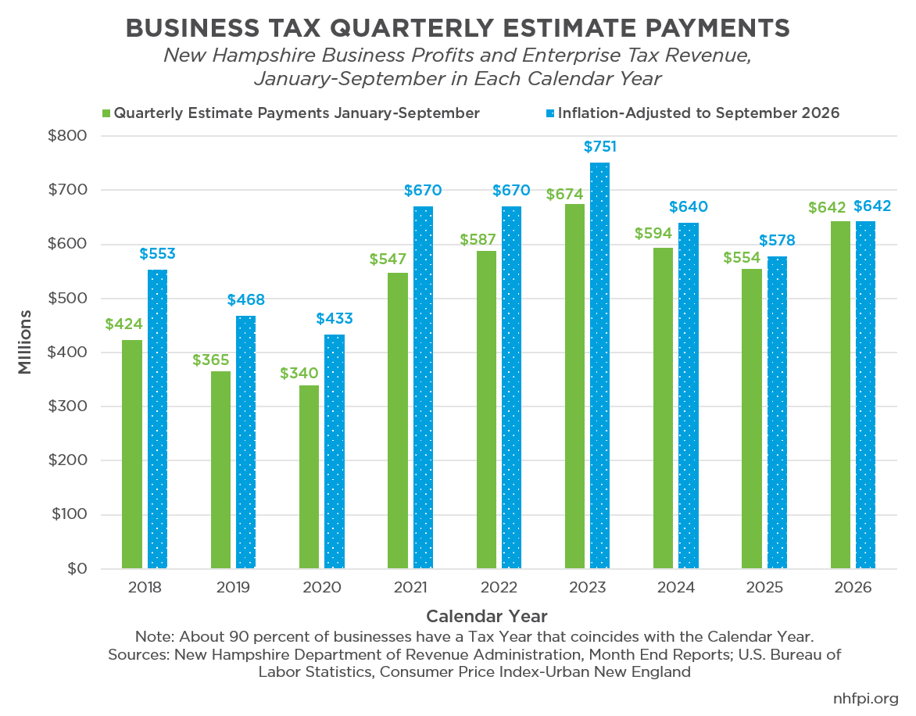
In other words, businesses may have underpaid earlier in the year, expecting lower profits, but then paid more in September to “catch up” with their required overall annual payment. Estimate payments for the calendar year 2026 through September were 58% higher than they were through August, showing the one-month boost was substantial. However, estimate payment boosts between August and September averaged 45% between 2018 and 2025, with 53% bumps in both 2020 and 2021, suggesting that, while high, the relative increase in September was not particularly abnormal.
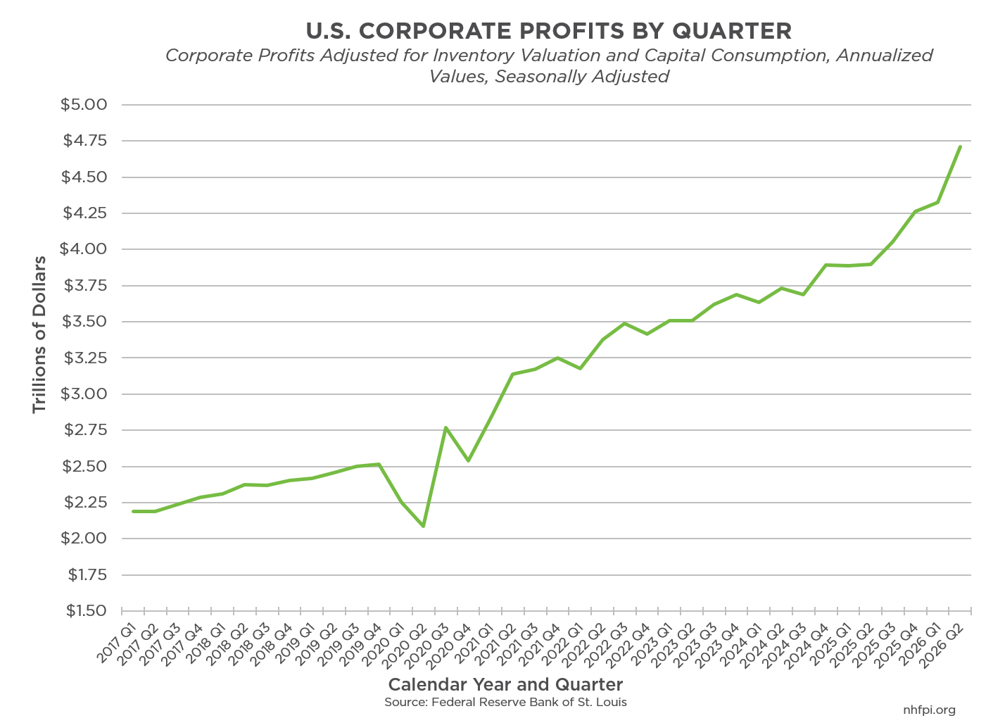
National corporate profits increased substantially in the last year. Large multi-state, multi-national filers are likely a significant component of the tax base in New Hampshire, as the latest DRA Annual Report showed that about 5% of paying business tax filers accounted for nearly 78% of the revenue collected, and more than two-thirds of BPT revenue collected in Tax Year 2023 came from complex, multi-component “Water’s Edge” entities that are more likely to operate in multiple jurisdictions.
Reverting Back to a Trendline After Policy Changes
Businesses may also be starting to pay more again, in line with overall economic and profit growth, after several policy changes lowered their tax liabilities. The cap on credit carryforward, lower business tax rates phased in over time, the shift to market-based sourcing and single-sales factor apportionment, and exempting Paycheck Protection Program dollars from BPT profits calculations have all changed how businesses have calculated their tax liabilities, and in most cases lowered their liabilities.
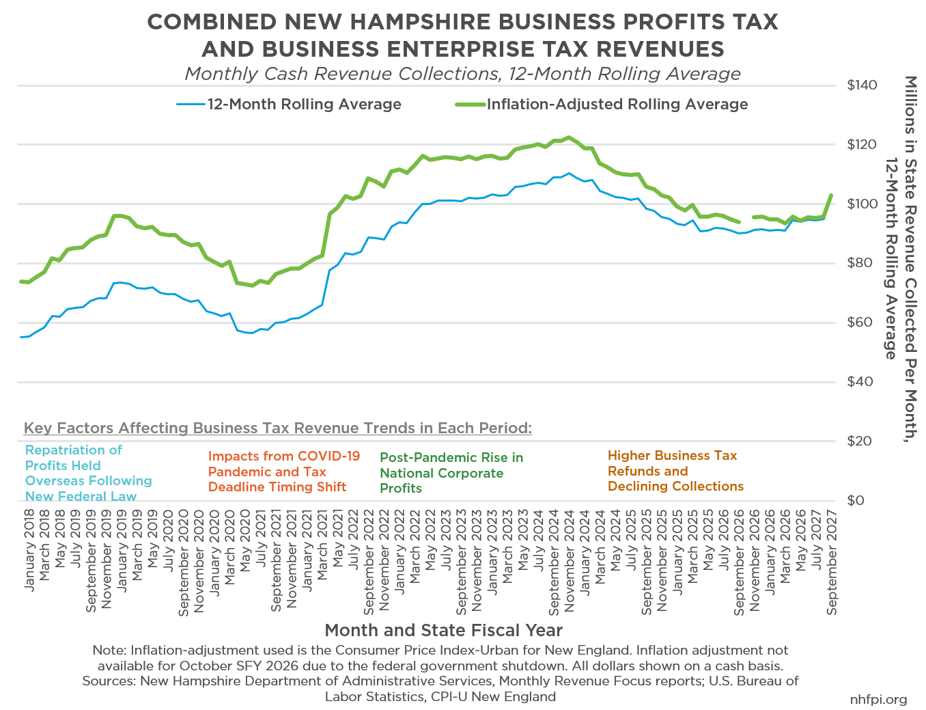
Whether adjusting for inflation or not, combined BPT and BET revenues remain lower than they did in the years immediately following the COVID-19 pandemic. The 12-month rolling average monthly revenue collection ending in September SFY 2027 is the highest since April SFY 2024, but also about the same amount as January SFY 2023. After adjusting for inflation in New England, the 12-month rolling average ending in September is the highest since October SFY 2025, but is also only slightly above the same measure for August SFY 2022.
September’s uptick is significant, particularly following a period when business tax revenues were relatively flat after declining for a time, but more data will be needed to determine whether this one month signals a trend.
Not Unique to New Hampshire
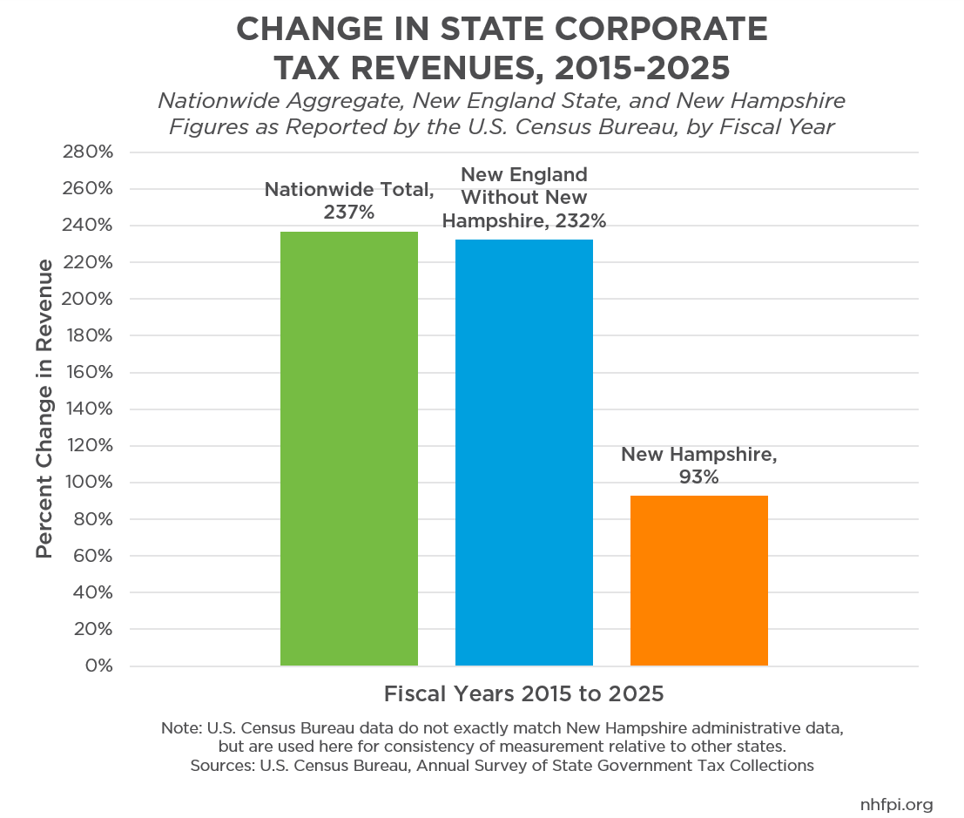
The rise in corporate tax revenues is not unique to New Hampshire, and the slump from SFY 2024 to SFY 2025 was larger, in percentage terms, in New Hampshire than among all state-level corporate tax collections nationwide, according to U.S. Census Bureau data.
Between fiscal years 2015 and 2025, New Hampshire combined BPT and BET revenues increased 93%, nearly doubling revenue collections, unadjusted for inflation, based on the U.S. Census Bureau’s historical dataset. That growth substantially changed State finances, but is lower, in percentage terms, than the growth in all corporate income tax collections by states nationwide, which more than tripled with a 237% increase. New Hampshire’s 93% increase in receipts is also lower than all other New England states individually during this period, including neighboring Maine (143%), Vermont (154%), and Massachusetts (185%).
New Hampshire’s tax revenues are likely substantially lower than they would have been without many of the tax policy changes impacting the BPT and BET. Between Tax Years 2015 and 2025, based on estimation methodologies previously used to measure forgone revenue, New Hampshire likely would have collected between $942 million and $1.39 billion more in revenue. Estimates for Tax Year 2024 alone suggest forgone revenue, relative to if tax rates had been at 2015 levels for the BPT and BET, were between $162 million and $239 million that year, and between $172 million and $253 million in Tax Year 2025. While BPT revenue grew, the lower BPT rates produced no detectable benefit to the New Hampshire economy, while iterative reductions in the BET rate were followed by reduced BET revenue.
Rising Revenues into the Fall?
The next substantial indicator of trends in business tax revenues will be in December, which is the net major quarterly estimate payment. Meanwhile, revenues from the other major revenue sources could continue to alter the picture.

Policymakers will likely be watching carefully to see how revenues trend through December to inform future State Budget discussions. With only one more major month of revenue before the Governor’s revenue projections are released in February, the importance of current State revenue trends to the next State Budget continues to grow.