KEY POINTS
-
- The Department of Health and Human Services faces a total $51 million back-of-budget funding reduction for the current State Budget biennium, which is the largest reduction in at least the last 30 years
- Approximately three-quarters of reductions for State Fiscal Year (SFY) 2026 came from one-time accounting adjustments that are not anticipated to be available again to meet required SFY 2027 reductions
- More than $10 million was reduced from behavioral and public health services, food assistance, family supports, and other health-related programs
- Looming fiscal challenges and federal policy changes could hinder the State’s ability to make future back-of-budget reductions without directly impacting services
The current New Hampshire State Budget was enacted during an uncertain and constrained fiscal environment. Policymakers faced significant expenditure needs, potential costs and federal policy shifts, and decreases in State revenue due in part to the previous choices of legislators, which resulted in more difficult funding tradeoffs for State Fiscal Years (SFYs) 2026 and 2027 than in the prior four budget cycles. As a result of these challenges, the enacted State Budget requires several agencies and departments to find additional savings through “back-of-budget” reductions.[1]
Back-of-budget reductions are spending cuts imposed by lawmakers that require state agencies to reduce expenditures after line-item appropriations have been established in the State’s Operating Budget. Rather than identifying all specific reductions through the State Budget, these reductions require State agency officials to decide how savings requirements can be met internally. Lawmakers typically require reducing General Fund expenditures through back-of-budget reductions to save the most flexible form of revenue for other needs. Depending on how the reductions are implemented, back-of-budget reductions can result in disruptions to programs and services that New Hampshire residents rely on.
A total of eleven State departments are required to comply with back-of-budget reductions during the SFYs 2026-2027 State Budget biennium, with the Department of Health and Human Services (DHHS) receiving the largest reduction of $51.0 million in General Funds, allocated as $25.5 million in each fiscal year.[2] This biennium’s required reduction is the largest back-of-budget reduction, in dollar terms, that the DHHS has faced in at least the last 30 years.[3]
The DHHS administers a broad range of services, including Medicaid, the Supplemental Nutrition Assistance Program (SNAP) and other food assistance programs, behavioral health supports, public health services, homelessness and shelter programs, child and family services, long-term supports for older adults and people with disabilities, and various other programs supporting the health and well-being of Granite Staters.[4] Unlike other State agencies, the DHHS is required by statute to report its back-of-budget reductions to the Joint Legislative Fiscal Committee for the SFYs 2026-2027 State Budget cycle.[5] Although these reductions are not publicly reported until after they have been implemented, limiting opportunities for input beforehand, the reporting requirement can provide transparency into how the DHHS met required savings, as well as provide insight into which programs and services were impacted the most.

One-Time Savings and Broader Impacts to Health Services
A total of $39.1 million was reduced from the DHHS’ budget for SFY 2026, the first year of reductions across the two-year budget biennium. This total reduction included the required $25.5 million reduction in General Funds, as well as a forgone $7.4 million in associated federal funds that would have supported the reduced expenditures.[6]
Nearly three-quarters ($28.4 million, 72.8%) came from one-time “prior year encumbrances,” or finalized contracts from prior fiscal years that were liquidated to generate savings without directly impacting services. The DHHS has categorized these reductions as one-time accounting adjustments, and indicated that similar savings are not expected to be available again to meet the required reductions for SFY 2027.
While these one-time adjustments likely helped minimize service impacts during the first year of reductions, the remaining $10.6 million (including $9.1 million in General Funds and $1.5 million in forgone Federal Funds) was met through reductions across various program areas.
Approximately $3.1 million (8.0% of the total reduction) was reduced from the Division for Behavioral Health, impacting provider contracts within community mental health services. Around $2.9 million (7.4%) came from the Division for Children, Youth, and Families budget lines, encompassing reductions for family intervention and prevention-related services. The Division for Economic Stability saw a $2.1 million (5.3%) reduction primarily from food assistance-related programming, while $1.6 million (4.0%) was reduced from child and maternal health services within the Division of Public Health. Smaller amounts were reduced from the Commissioner’s Office ($918,207; 2.4%) and the Division of Long-Term Supports and Services ($94,890; 0.2%).
Mental Health and Homelessness Services
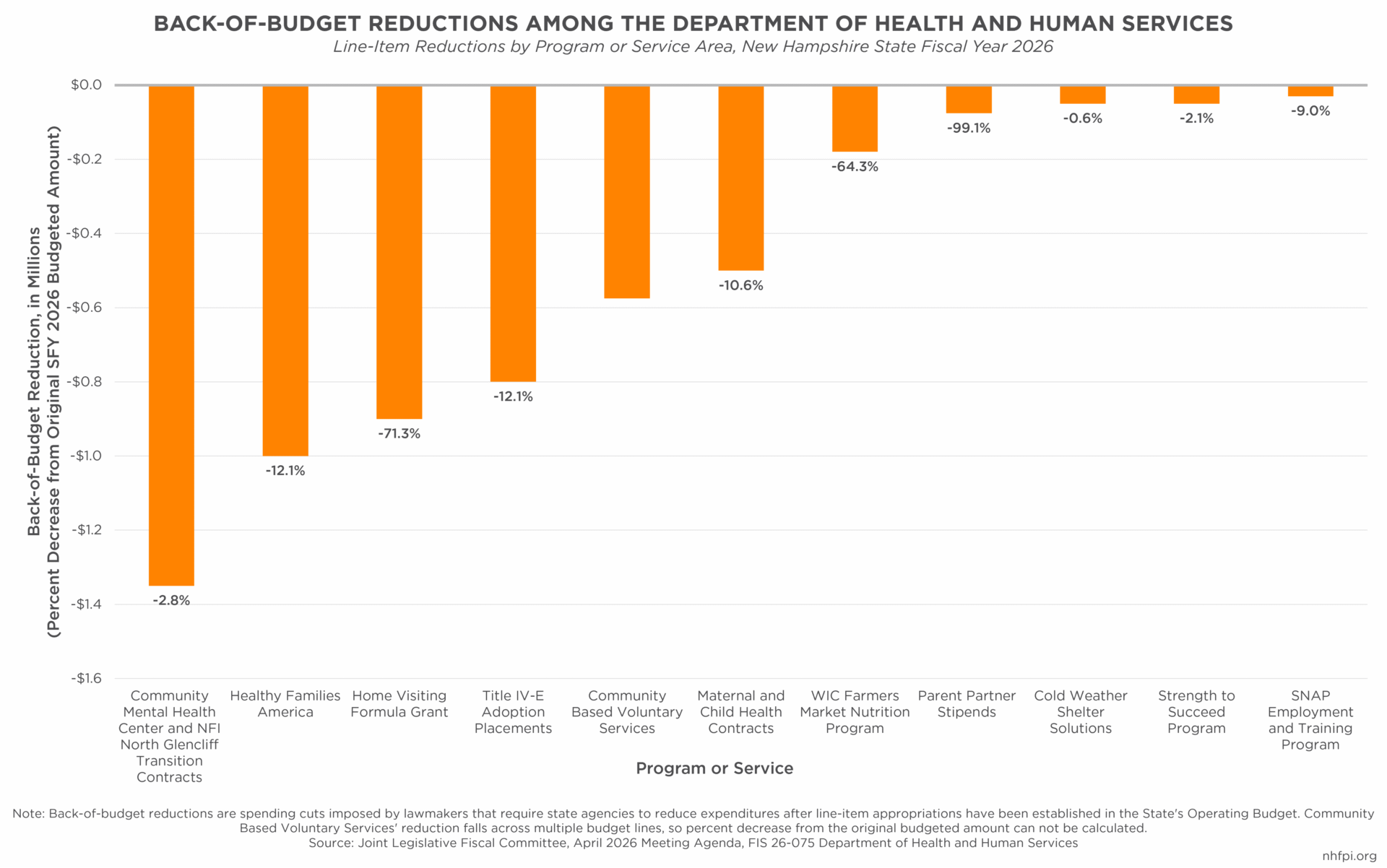
A total of $1.4 million (2.8% decrease from original budgeted amount for SFY 2026) was reduced among community mental health program service contracts, including an $850,000 reduction from the state’s Community Mental Health Centers (CMHCs). With input from New Hampshire’s ten CMHCs, the DHHS revised its state contracts by eliminating certain training and system infrastructure updates, as well as through a “reorganization” of Critical Time Intervention (CTI) services. CTI is an intensive care transition program that helps connect people to community-based supports upon discharge from a psychiatric inpatient setting. These services have played an important role in helping to reduce hospital readmissions and shorten inpatient stays for individuals who can safely transition to at-home, community-based support.[7] According to State Budget documents, an estimated 350 people were served through the CTI program during prior years, with a goal of reaching 400 Granite Staters during SFY 2026.[8]

While the broader impacts of eliminating certain training infrastructure among CMHCs are not yet known, New Hampshire continues to face behavioral health workforce shortages. Training and professional development can be important for supporting recruitment and retention efforts, with reduced investment potentially making it more difficult to sustain workforce capacity over time.
An additional $500,000 reduction impacted a State contract with the nonprofit organization NFI North to support resident transitions out of Glencliff Home, a long-term medical facility providing inpatient care for adults aged 60 or older with developmental disabilities or mental health conditions.[9] The DHHS indicated that the reductions were met through staffing budget adjustments without an anticipated impact on personnel, although it is unclear how these reductions could affect current and future staffing decisions or operations.
In addition to larger community mental health contract changes, a smaller but still notable amount of $50,000 (0.6%) was reduced from program service contracts among the state’s shelter programs serving unhoused Granite Staters. This reduction impacted the Cold Weather Program in particular, requiring providers to restructure the program through centralized access and greater reliance on the existing emergency shelter system. Although it is unclear how this reduction could impact future programming, a total of fourteen cold weather shelters were in operation across the state during the 2025-2026 winter season.[10]
The remaining reductions within the Division for Behavioral Health encompassed administrative adjustments and accounting changes, rather than direct service reductions. These changes included $1.1 million in savings through a new rapid response contract that required fewer resources than was anticipated in the State Budget formulation process; $500,000 savings through Opioid Abatement Funds that replaced State General Funds for a Recovery Friendly Workplace Initiative contract; and $117,293 savings from the Choose Love program, which provides social and emotional learning in schools across the state and was suspended for this biennium by the back-of-budget reduction.[11]
Youth and Family Supports
Several budget lines within the Division for Children, Youth, and Families (DCYF) were reduced to SFY 2025 spending levels to help meet required back-of-budget reductions for the fiscal year. According to the DHHS, most services could continue to operate at SFY 2025 expenditure levels with no impact on current service capacity, unless more families or children required services. However, because of inflation, the purchasing power of SFY 2025 expenditure levels would be lower after adjusting to SFY 2026 dollars, potentially reducing the amount of services that could be supported. Using SFY 2025 expenditure levels limits capacity for enhanced services, responding to greater community and youth needs, and to budget effectively while avoiding overspending appropriations.
The largest reduction for DCYF, and one of the largest service reductions across the entire DHHS this fiscal year, was a $1.0 million cut to the budget line supporting the Healthy Families America Initiative. This reduction returned funding to SFY 2025 spending levels and represented about a 12.1% decrease from the amount originally budgeted for SFY 2026. Healthy Families America is an evidence-based home visiting model designed to support child development, connect families with community resources, and strengthen economic stability and support for new parents.[12]
An additional $800,000 reduction was made to Title IV-E Adoption Placements, also returning funding to SFY 2025 spending levels and resulting in an estimated 12.1% decrease from the original SFY 2026 appropriation. The DHHS identified that this reduction could result in challenges if adoption placements increase, as SFY 2025 spending levels would not leave funding available to respond to additional needs without reductions elsewhere.
A total of $575,000 was reduced from Community Based Voluntary Services (CBVS) falling across multiple budget lines, aligning appropriations more closely with SFY 2025 spending levels. CBVS is a short-term, prevention-focused program that helps prevent continued involvement with the child welfare system by connecting participants with community resources and strengthening parenting skills. This prevention-focused program may help to reduce future DCYF costs and more intensive system involvement down the road. CBVS serves an estimated 800 families statewide each year, with only around 500 families expected to be reached following these reductions.[13]
A smaller but still significant $75,145 reduction (99.1%) was made to stipends for the Parent Partner Program, which connects parents and caretakers with living experience in the child welfare system to other families currently involved with the system to provide mentoring and support. The program has been vital in helping to ensure families with living experience have a meaningful voice and can provide input in the child welfare process.[14] An additional $50,000 was reduced (2.1%) from the Strength to Succeed contract, which is a similar peer-support model that helps at-risk families better navigate the system.[15]
The DHHS also made smaller reductions to dental services at the Sununu Youth Services Center (SYSC), totaling $22,000 across dental and hygienist budget lines. Equine therapy services were suspended for the biennium, generating an additional $12,000 in savings for SFY 2026. Lawmakers have made several efforts to close the SYSC entirely, as the number of individuals served by Center has been a substantially smaller number than the facility’s capacity in recent years, with the current State Budget calling for the sale of the SYSC during this biennium.
Food Assistance and Economic Stability Programs
A total of $2.1 million was reduced within the Division for Economic Stability, which manages a variety of the state’s assistance programs, including SNAP; the Women, Infants, and Children Nutrition Program (WIC); the Child Care Scholarship Program (CCSP); and various other supports for Granite State families. Most of the reductions during this fiscal year impacted food assistance initiatives.
A smaller amount of $30,000, including a forgone $15,000 in federal funds, was reduced from the SNAP Employment and Training Program, representing a 9.0% reduction from the original SFY 2026 budgeted amount. This program helps SNAP participants build job skills, earn educational credentials, and find employment, which may be a valuable resource for helping SNAP participants fulfill work requirements to receive benefits or transition off SNAP entirely.[16] As a result of this reduction, the DHHS, which is already experiencing staffing shortages, identified that it will be absorbing additional marketing and outreach work around the program.
Although housed under the Division of Public Health, budget reductions led to a notable $180,000 decrease for the WIC Farmers Market Nutrition Program, contributing to a 64.3% decrease from the original budgeted amount for SFY 2026. This program provides participants with vouchers to purchase fresh, locally grown produce at farmers’ markets and eligible roadside stands.[17] While no current services were impacted, according to the DHHS, reductions will impact the ability for the program to expand and provide services for more families, and the DHHS noted there may be tradeoffs relative to other State priorities to successfully administer this program.
Most of the remaining reductions reflected contract adjustments or changes in funding sources, rather than a reduction in services. The DHHS was able to save $1.8 million from unused funds that were contracted through the New Hampshire Food Bank to provide support for SNAP participants who had their benefits interrupted during the federal government shutdown in 2025.[18] Other smaller adjustments included $50,000 in combined General and Federal Fund savings from a Summer EBT Program (which helps students who receive free and reduced-price meals at school maintain access to food during summers with electronic benefit transfer cards) outreach contract that did not move forward, as well as $50,000 in savings resulting from an administrative delay with the New Hampshire Food Bank’s State-contracted SNAP Incentive Program.
Outside of food assistance programming, $100,000 in savings resulted from the utilization of available federal funds to support the Child Care Scholarship Program Presumptive Eligibility Pilot Program that was established under the current State Budget.
Public Health Services
A total of $1.6 million in appropriations were eliminated within the Division of Public Health, with reductions primarily occurring across child and maternal health programming. The largest reduction, which was $900,000, came from the Home Visiting Formula Grant, contributing to a 71.3% decline from the original budgeted amount for SFY 2026. The Home Visiting Program is a voluntary program providing at-home visits to expectant and new parents, reflecting characteristics included in the Healthy Families America model. The Program’s overall goal is to improve health outcomes among families, enhance economic stability and well-being, and help prevent child abuse and neglect.[19] Although current participants are not expected to lose services, the DHHS indicated that the reduction will limit the program’s ability to expand and reach additional families. According to data from the Prenatal-to-3 Policy Impact Center, the program already faces limitations in New Hampshire, with only 7.2% of eligible Granite State children under the age of three served through the program in 2019, the most recent year of data available.[20]
An additional $500,000 was reduced among the Maternal and Child Health Program’s primary care contracts, leading to a 10.6% decrease from the original SFY 2026 budgeted amount. While there was no impact on current services, according to the DHHS, reductions will prevent the program from expanding this fiscal year and reaching more families across the state. The Maternal and Child Health Program contracts with a wide range of providers across the state to improve health outcomes and provide access to primary and preventive care among families with the greatest need. While the DHHS did not identify which specific contracts would be impacted by this reduction in their description provided to the Joint Legislative Fiscal Committee, larger contracted entities providing direct services include the state’s Community Health Centers and the Injury Prevention Center at Dartmouth Health’s Children’s Hospital.[21]
Conclusion and Future Considerations
During a time of fiscal uncertainty and declining revenue, State health officials are facing difficult decisions in order to meet required back-of-budget reductions during the State Budget biennium. While one-time accounting adjustments generally helped minimize the magnitude of service impacts in SFY 2026, several health programs experienced reductions throughout the year, impacting behavioral health care, child and family prevention services, public health programs, food assistance, and other areas. Although the DHHS indicated that existing services were not directly impacted by most of these reductions, decreased available funding may limit the capacity of these programs to expand their services and serve all Granite Staters who need assistance.
The DHHS relied on one-time accounting adjustments to achieve nearly three-quarters of the required savings this past fiscal year. However, the DHHS has indicated that comparable one-time savings are not expected to be available to meet the additional $25.5 million in General Fund reductions required for SFY 2027. Without those savings, State health officials will likely face more difficult decisions as they work to meet these legislatively-imposed reductions, which could lead to a larger impact on services than what was experienced this prior fiscal year.
These future back-of-budget reductions also come as the State prepares for several federal policy changes and broader fiscal challenges heading into the next State Budget cycle. Beginning as early as this upcoming fall and winter, new federal Medicaid work and cost-sharing requirements could likely increase administrative burdens for the DHHS, which already continues to experience ongoing staffing shortages. Additionally, federally required reductions to Medicaid provider taxes, along with potential State funding obligations for SNAP benefits, could further constrain available revenue streams and limit the State’s ability to sustain health-related services.[22]
As these fiscal changes unfold and further back-of-budget reductions take effect, the cumulative impacts on New Hampshire’s health system will likely become more apparent in the future. Continued monitoring of both State and federal funding changes will be important for understanding the magnitude of impacts on health care access and assistance for all Granite Staters.
Appendix
| NEW HAMPSHIRE DEPARTMENT OF HEALTH AND HUMAN SERVICES BACK-OF-BUDGET REDUCTIONS FOR STATE FISCAL YEAR 2026 |
||||
| Program or Service Area |
General Fund Reduction |
Federal Fund Reduction |
Total Reduction | Description of Reduction and Program |
| One-Time Prior Year Encumbrances | $16,391,770 | $5,882,403 | $28,422,769 | The DHHS liquidated finalized contracts from prior fiscal years, with no impact to services. The DHHS categorized these reductions as “one-time” accounting adjustments that are not expected to be available again to meet SFY 2027 reductions. |
| Title IV-E Adoption Placements |
$400,000 | $400,000 | $800,000 | Funds were reduced to SFY 2025 spending levels. The DHHS identified that this reduction could result in challenges if adoption placements increase. |
| Parent Partner Program (Participant Stipends) | $30,000 | $45,145 | $75,145 | Funds were reduced to SFY 2025 spending levels. Reductions appear to only impact stipends for program participants. This program connects parents and caretakers with living experience in the child welfare system to other families currently involved with the system to provide mentoring and support. |
| SYSC Target Model | $25,000 | $0 | $25,000 | Training activities were reduced during the first half of SFY 2026. |
| SYSC Dental Needs | $22,000 | $0 | $22,000 | Funds were reduced to SFY 2025 spending levels. The DHHS identified that this reduction could result in challenges if more people need services. |
| SYSC Catholic Medical Lab Services | $17,000 | $0 | $17,000 | Funds were reduced to SFY 2025 spending levels. The DHHS identified that this reduction could result in challenges if more people need services. |
| SYSC Equine Therapy | $12,000 | $0 | $12,000 | Equine therapy services at YDC were suspended for the biennium. |
| Community Based Voluntary Services | $475,000 | $100,000 | $575,000 | Funds were reduced to SFY 2025 spending levels. CBVS is a short-term, prevention focused program that helps prevent continued involvement with the child welfare system by connecting participants with community resources and strengthening parenting skills, and serves approximately 800 families statewide each year. |
| Healthy Families America | $500,000 | $500,000 | $1,000,000 | Funds were reduced to SFY 2025 spending levels. Healthy Families America is an evidence-based home visiting model designed to support child development, connect families with community resources, and strengthen economic stability and support for new parents |
| UNH Cooperate Project Agreement (Training Activities) | $147,500 | $147,500 | $295,000 | DHHS amended the contract to remove the virtual conference option, as well as reduce the originally scheduled two day conference to a one-day conference. |
| Strength to Succeed Contract | $50,000 | $0 | $50,000 | Funds were reduced to SFY 2025 spending levels. This program is a peer-support model that helps at-risk families navigate the child welfare system. |
| Summer EBT Outreach | $25,000 | $25,000 | $50,000 | A Summer EBT Outreach contract did not move forward, freeing up available funds. |
| CCSP Presumptive Eligiblity Pilot Program | $100,000 | $0 | $100,000 | These funds were replaced with federal funds to support implementation of the pilot program, that was established under the current State Budget. |
| NH Food Bank Contract (SNAP Incentive) | $50,000 | $0 | $50,000 | Adjustments to a newly approved contract led to a pro-rated reduction of $50,000 during the first year. |
| SNAP Employment and Training (Marketing and Outreach) | $15,000 | $15,000 | $30,000 | The DHHS, which is already experiencing staffing shortages, identified that it will be absorbing additional marketing and outreach work. This program helps SNAP participants build job skills, earn educational credentials, and find employment. |
| NH Food Bank (SNAP Funding Challenge) | $1,827,757 | $0 | $1,827,757 | These funds were remaining from a terminated NH Food Back contract that supported SNAP participants who lost benefits during the 2025 federal government shutdown. |
| Home Visiting Formula Grant | $900,000 | $0 | $900,000 | Although current participants are not expected to lose services, the DHHS indicated that the reduction will limit the program’s ability to expand and reach additional families. This is a voluntary program providing at-home visits to expectant and new parents, reflecting characteristics included in the Healthy Families America model. The Program’s overall goal is to improve health outcomes among families, enhance economic stability and well-being, and help prevent child abuse and neglect. |
| Maternal & Child Health Primary Care Contracts | $500,000 | $0 | $500,000 | While there was no impact on current services, according to the DHHS, reductions will prevent the program from expanding this fiscal year and reaching more families across the state. The program contracts with a wide range of providers across the state (CHCs, Dartmouth Health, etc.) to improve health outcomes and provide access to primary and preventive care among families with the greatest need. |
| WIC Farmers Market Nutrition Program | $180,000 | $0 | $180,000 | While no current services were impacted, according to the DHHS, reductions will impact the ability for the program to expand and provide services for more families. This program provides participants with vouchers to purchase fresh, locally grown produce at farmers’ markets and eligible roadside stands. |
| Choose Love | $117,293 | $0 | $117,293 | The Choose Love program was suspended for the biennium following the vacancy of the one full-time position, resulting from prior reductions under the current State Budget. This program provides social and emotional learning in NH schools. |
| Granite United Way Contract (Recovery Friendly Workplace) | $500,000 | $0 | $500,000 | These funds were replaced with Opioid Abatement Funds, freeing up available funds. |
| Rapid Response Services | $1,100,000 | $0 | $1,100,000 | This new contract required fewer resources than was anticipated in the State Budget formulation process. |
| Cold Weather Shelter Services | $50,000 | $0 | $50,000 | This reduction requires providers to restructure the program through centralized access and greater reliance on the existing emergency shelter system. Although it is unclear how this reduction could impact future programming, a total of 14 cold weather shelters were in operation across the state during the 2025-2026 winter season. |
| NFI North Contract (Glencliff Transitions) | $500,000 | $0 | $500,000 | The DHHS indicated that the reductions were met through staffing budget adjustments without an anticipated impact on personnel, although it is unclear how these reductions could affect current and future staffing decisions or operations. This contract supports transitions out of Glencliff Home, a long-term medical facility providing inpatient care for adults aged 60 or older with developmental disabilities or mental health conditions. |
| Community Mental Health Center Contracts | $850,000 | $0 | $850,000 | With input and agreement from the state’s 10 CMHCs, the DHHS amended contracts to remove general training and system upgrades, as well as a reorganization of Critical Time Intervention services. CTI is an intensive care transition program that helps connect people to community-based supports upon discharge from a psychiatric inpatient setting, with approximately 350 people served during prior fiscal years. |
| Continuing Education Shared Pool | $74,890 | $0 | $74,890 | Funds were replaced with federal funds, freeing up available funds. |
| Special Medical Services (Consultants Line) | $20,000 | $0 | $20,000 | These funds were originally set aside to support expected emerging needs. SMS provide care coordination and financial services for people seeking LTSS. |
| DHHS Rent and Lease | $619,790 | $298,417 | $918,207 | DHHS negotiated a cheaper rent and lease price. |
| Total | $25,500,000 | $7,413,465 | $39,062,061 | |
| Sources: Joint Legislative Fiscal Committee, April 2026 Meeting Agenda, FIS 26-075 DHHS | ||||
End Notes
[1] For more information on the current State Budget, see NHFPI’s July 2025 Report, The State Budget for Fiscal Years 2026 and 2027. For more information on the State Budget process, see NHFPI’s February 2017 Publication, Building the Budget: New Hampshire’s State Budget Process and Recent Funding Trends.
[2] While not technically a back-of-budget reduction, the Governor is required to increase state General Fund revenues or decrease appropriations by a combined total of $16 million each fiscal year during the State Fiscal Years 2026-2027 budget biennium.
[3] See the New Hampshire Office of Legislative Budget Assistant, Budget Revenue Documents, Operating Budgets.
[4] For more information, see the New Hampshire Department of Health and Human Services’ February 2025 presentation to the House Finance Committee, DHHS Budget Overview.
[5] See the New Hampshire State Budget for State Fiscal Years 2026-2027, page 729.
[6] For all back-of-budget reduction amounts and DHHS’ descriptions, see the Joint Legislative Fiscal Committee, April 2026 Meeting Agenda, FIS 26-075 Department of Health and Human Services, page 25.
[7] For more information on Critical Time Invention services, see the New Hampshire Department of Health and Human Services’ webpage, Critical Time Intervention.
[8] See the New Hampshire Department of Health and Human Services, Budget Briefing Book, Division of Behavioral Health, page 32.
[9] For more information on the Glencliff Home, see the New Hampshire Department of Health and Human Services’ webpage, Glencliff Home.
[10] See the New Hampshire Department of Health and Human Services’ one-pager, New Hampshire Emergency Shelter Cold Weather Resources (Winter 2025-2026).
[11] For more information on Choose Love, see the New Hampshire Children’s System of Care’s webpage, Choose Love Movement.
[12] For more information on Healthy Families America, see the New Hampshire Department of Health and Human Services’ webpage, Healthy Families America New Hampshire.
[13] For more information on Community Based Voluntary Services, see Waypoint’s webpage, Four Years In: How CBVS Is Changing the Landscape of Prevention in Child Welfare and the New Hampshire Department of Health and Human Services’ November 2020 press release, DHHS To Partner With Waypoint, Family Resource Center Of Northern New Hampshire For Community-Based Voluntary Services. Updated caseload data was acquired from Waypoint.
[14] For more information on the Parent Partner Program, see the New Hampshire Department of Health and Human Services’ webpage, Parent Partner Program.
[15] For more information on the Strength to Succeed Program, see the New Hampshire Department of Health and Human Services, Budget Briefing Book, Division for Children, Youth, and Families, page 24.
[16] For more information on the Employment and Training Program, see the U.S. Department of Agriculture’s webpage, SNAP E&T State Agency/Providers.
[17] For more information on the Women, Infants, and Children (WIC) Program, see the New Hampshire Department of Health and Human Services’ webpage, WIC Farmer’s Market Nutrition Program.
[18] For more information on the federal government shutdown and associated impacts to food security, see NHFPI’s November 2025 blog, Up to 76,000 Granite Staters, Particularly in Rural Areas, Face Food Assistance Disruptions Amid Federal Shutdown.
[19] For more information on the Home Visiting Program, see the New Hampshire Department of Health and Human Services’ webpage, Home Visiting and the U.S. Health Resources and Services Administration’s webpage, Maternal, Infant, and Early Childhood Home Visiting (MIECHV) Program.
[20] See the Prenatal-to-3 Policy Impact Center, Evidence-Based Home Visiting Programs, New Hampshire.
[21] For more information on the Maternal and Child Health Program, see the New Hampshire Department of Health and Human Services, Budget Briefing Book, Division of Public Health Services, pages 18-20.
[22] For more information on federal funding and policy changes, see NHFPI’s August 2025 Issue Brief, New Federal Reconciliation Law Reduces Taxes, Health Access, and Food Assistance Supports for Granite Staters. For more information on changes to provider taxes in particular, see NHFPI’s February 2026 Report, Hospital Provider Taxes and Support for Medicaid Financing in New Hampshire.