603 Day is all about celebrating what makes New Hampshire special: its people, communities, local businesses, and places that give the Granite State its character. But it’s also a time to celebrate the progress, resilience, and opportunities shaping life here today.
At the New Hampshire Fiscal Policy Institute, we spend a lot of time examining the challenges facing New Hampshire, including housing affordability, child care costs, and property taxes. But the data also tell another story too.
So for 603 Day, we’re highlighting five pieces of good news happening across New Hampshire right now. From signs of economic resilience to policy choices that are making a difference for Granite Staters, these stories offer reminders that, even amid real challenges, there are still plenty of reasons to feel hopeful about New Hampshire’s future.
Housing Price Increases are Slowing in Some Areas
While the median price for a single-family house has continued to climb in New Hampshire, recent trends suggest that the pace of growth may be slowing in some parts of the state. From 2024 to 2025, the statewide median price increased by 3.9%, the smallest annual gain since 2016. The median sale price in two counties, Coos and Sullivan, actually declined slightly between these two years, although prices remained high, particularly relative to incomes in these counties.

These changes, while increasing the price of housing in most cases, are all much smaller increases than Granite Staters faced earlier in the decade. During the height of the COVID-19 pandemic and associated housing market pressures, the median sale price surged by 17.9% between 2020 and 2021, which was the largest annual increase in recent history. Slower increases in housing prices suggest that, for people looking to move to New Hampshire and add to the state’s population and labor force, the gap between income growth and housing price growth may have narrowed, making affording a home closer to a reality than it was earlier this decade.
Drug-Related Deaths Have Declined
In 2024, approximately 287 Granite Staters died from drug-related causes, the smallest number recorded in the state since 2014 and the sharpest year-over-year reduction (33.4%) across the previous ten years. Early indicators suggest that positive trends continued. Preliminary data from 2025 show an estimated 256 drug-related deaths throughout the year, which would represent a 10.8% decline from 2024 if the numbers are not revised. These sharp declines follow a decade of increased investments for prevention, treatment, and recovery services, which likely helped Granite Staters more readily access support for substance use disorders.

Projected First-Year Enrollment at UNH Has Increased
As of May 2025, administrators at the University of New Hampshire (UNH)’s Durham campus received 2,471 deposits from new freshman year students for the upcoming 2026-2027 school year, representing a reported 4% annual increase. According to publicly available enrollment data, UNH has seen a steady decline in freshman year enrollment since 2022.

These changing trends come during a time when New Hampshire continues to lose younger residents under age 26. Between the 2022 and 2023 tax filing periods, the state experienced a net loss of nearly 1,000 tax filers under age 26, suggesting challenges retaining younger adults and recent graduates. Steep higher education costs and limited access to affordable public higher education may contribute to more young residents leaving the state for college and career opportunities.
Child Poverty Was Cut in Half in 2021
Based on the Supplemental Poverty Measure (SPM), poverty among children under age 18 was reduced by more than half during the COVID-19 pandemic, dropping from 8.2% in 2019 to 4.0% in 2021. Unlike the Official Poverty Measure (OPM), the SPM accounts for taxes and tax credits, regional differences in costs of living, and other factors that can help highlight the economic challenges Granite Staters are facing. While child poverty has since rebounded to pre-pandemic levels, prior declines underscore the importance of governmental assistance during the pandemic, with 2021 expansions to the Child Tax Credit likely contributing to deductions.
Using the OPM, child poverty remained similar to overall poverty in New Hampshire in the years since the initial recovery from the pandemic, and overall poverty is still low relative to most other states. The OPM does not adjust for regional variations in living costs in most of the country; by this measure, about 99,000 Granite Staters lived in poverty, which is a higher population than in any city or town in the state except Manchester. The Child Tax Credit expansion shows that public policy can effectively reduce material hardship, including in a place that, relative to the rest of the country, still has relatively low
New Hampshire’s Roads and Bridges Have Improved
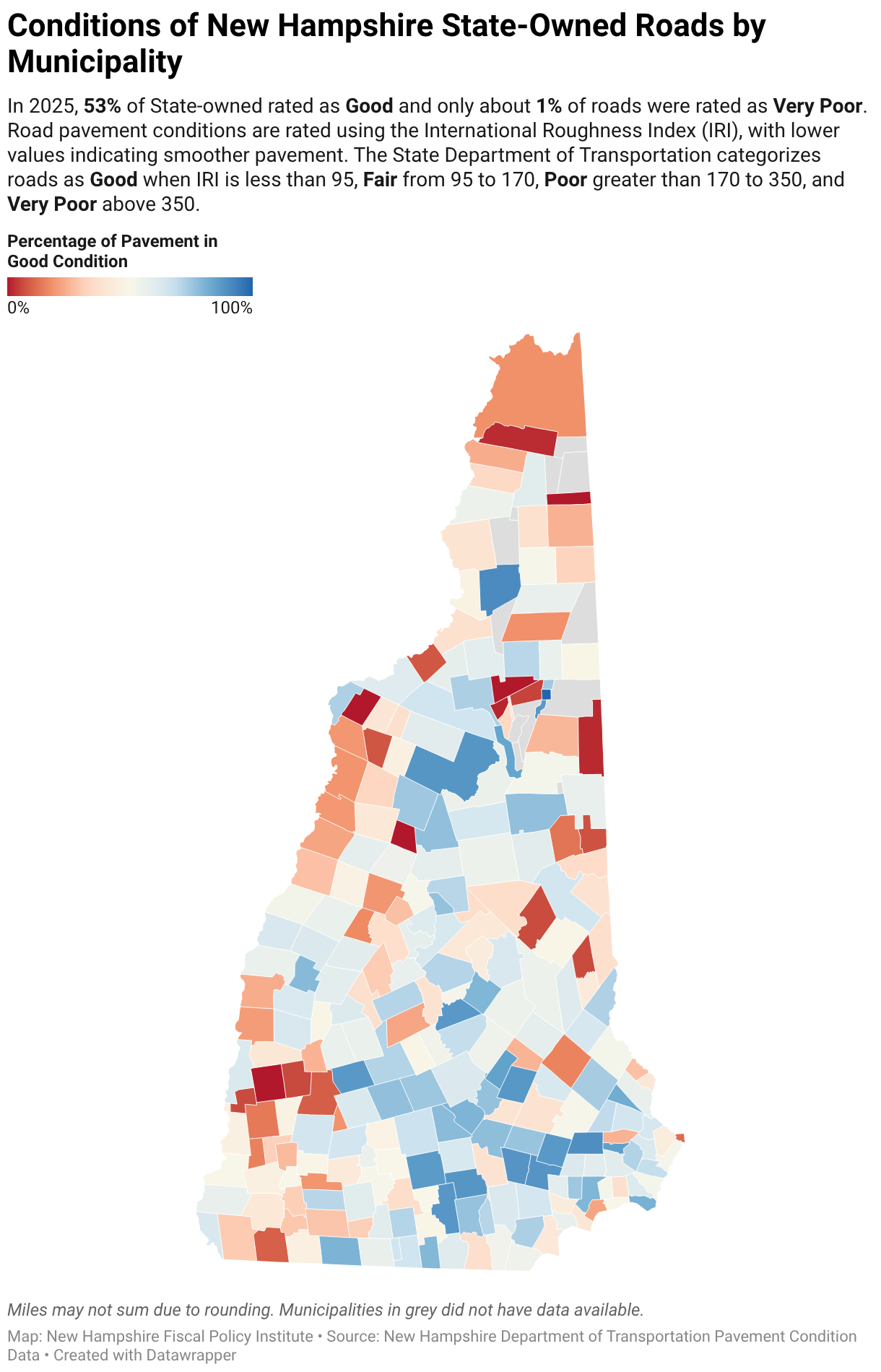
New Hampshire has made significant progress improving transportation infrastructure over the last decade, with the share of State-maintained roads rated in “Good” or “Fair” condition, as measured by the International Roughness Index (IRI), increasing from 68% in 2014 to 85% in 2024. The state’s number of red-listed bridges, or those that have at least one poor rating of a major structural element, has also declined substantially over the years. The number of State-owned, red-listed bridges has dropped by about 24% since 2016, while the number of municipal, red-listed bridges has dropped by 62% during the last decade.