
The U.S. Census Bureau releases data every September that provide insights into the economic well-being of both Granite Staters and all U.S. residents in the prior year. The most recent data, released on September 11, suggest that many of the metrics used to estimate the economic well-being of New Hampshire residents did not show marked improvements, but remained relatively stable between 2023 and 2024.

New Hampshire Household Incomes Did Not Grow Last Year
The estimated median household income in New Hampshire was $99,782, based on data collected by the American Community Survey during 2024. The median reflects the income level at which half of households have higher incomes, and half have lower incomes. This median income estimate does not differ from the $96,838 estimated for 2023 when accounting for statistical uncertainty. After taking inflation into account, the median household income effectively maintained the same spending power for the median household as in 2021 and 2023, which were slightly higher than the 2022 estimates when median household income fell behind inflation.
The inflation-adjusted 2024 household incomes were higher than before the COVID-19 pandemic and prior to the Great Recession of 2007-2009, and reflected the relative speed of the post-pandemic recovery compared to the slow recovery from the Great Recession.
Of the estimated 570,689 households in New Hampshire in 2024, 24 percent, or slightly less than one in four, had pre-tax incomes below $50,000 annually. About 16 percent had incomes lower than $35,000, and 11 percent had estimated incomes below $25,000 during 2024. Nearly one in three (30 percent) households had incomes over $150,000, and roughly 17 percent had incomes of $200,000 or more.
The percentage of households with incomes of $200,000 or more and $75,000 to $99,999 increased by about 1 percent compared to 2023 breakdowns, while the percentages of all other household income groups remained stable between 2023 and 2024 when adjusting for statistical uncertainty.

The average household size in New Hampshire was approximately 2.4 people in 2024. The Massachusetts Institute of Technology estimated the living wage income for a two-person household in New Hampshire in 2025 was $71,643 for two adults, $93,451 for one adult with one child, and $104,373 for two working adults with one child. The Economic Policy Institute estimated the income a family needed in 2024 for a “modest yet adequate standard of living,” which does not include costs such as paying for student loans or for homeownership as well as for any form of entertainment, ranged from $75,966 to $101,336 for a household with two adults and one child, depending on where they lived in New Hampshire.
Over 98,000 Granite Staters Lived Below the Poverty Line in 2024
The poverty rate represents the portion of the population with very limited incomes and is measured by Official Poverty Measure (OPM). The OPM uses pre-tax income and is underpinned by a calculation based on research published in 1955 that estimates the cost of a federally-defined food plan and multiplies that cost by three.
The Official Poverty Measure thresholds for 2024 are $16,320 for a single person under 65 years old, $21,621 for a two-person household with one child and one adult under 65, $25,249 for a three-person household with one child, and $31,812 for a four-person household with two children.
An estimated 98,600 Granite Staters (7.2 percent) lived with incomes below Official Poverty Measure poverty thresholds in 2024. This estimate is about the same as the estimated 2024 combined populations of Claremont, Concord, Keene, and Laconia. That total number of people in poverty included about 16,000 children and roughly 23,000 older adults.

The overall poverty rate in New Hampshire was the same estimated rate as during 2021, 2022, and 2023, and statistically indistinguishable from the 7.3 percent poverty rate from 2019. The estimated poverty rate for children was 6.6 percent, which was statistically indistinguishable from the 2023 rate. Poverty for older adults, at an estimated 7.8 percent, was also substantially unchanged from 2023, but remained higher than it was in 2019.
Using a different poverty measure that accounts for tax credits and geographic variations in housing costs shows average poverty rates between 2022 to 2024 to be higher than the Official Poverty Measure estimates. This gap suggests the Official Poverty Measure may be underestimating the number of Granite Staters with limited incomes who struggle to meet their basic needs, particularly relative to housing costs and access to certain types of public assistance.
Within the Official Poverty Measure data for New Hampshire, 2024 continued to show longstanding differences in economic hardship between groups, reflecting both historical and present-day barriers to opportunity that hinder upward mobility. While data limitations prevent a reliable, comprehensive analysis of 2024 data, the estimated poverty rates for Granite Staters identifying as of two or more races and those identifying at Hispanic or Latino were higher than for white residents who did not identify as Hispanic or Latino. Data to be published in December 2025 will provide more reliable, in depth insights into the well-being of groups and geographies within the Granite State.
Rate of Granite Staters Without Health Insurance Remains Stable at 4.5 Percent
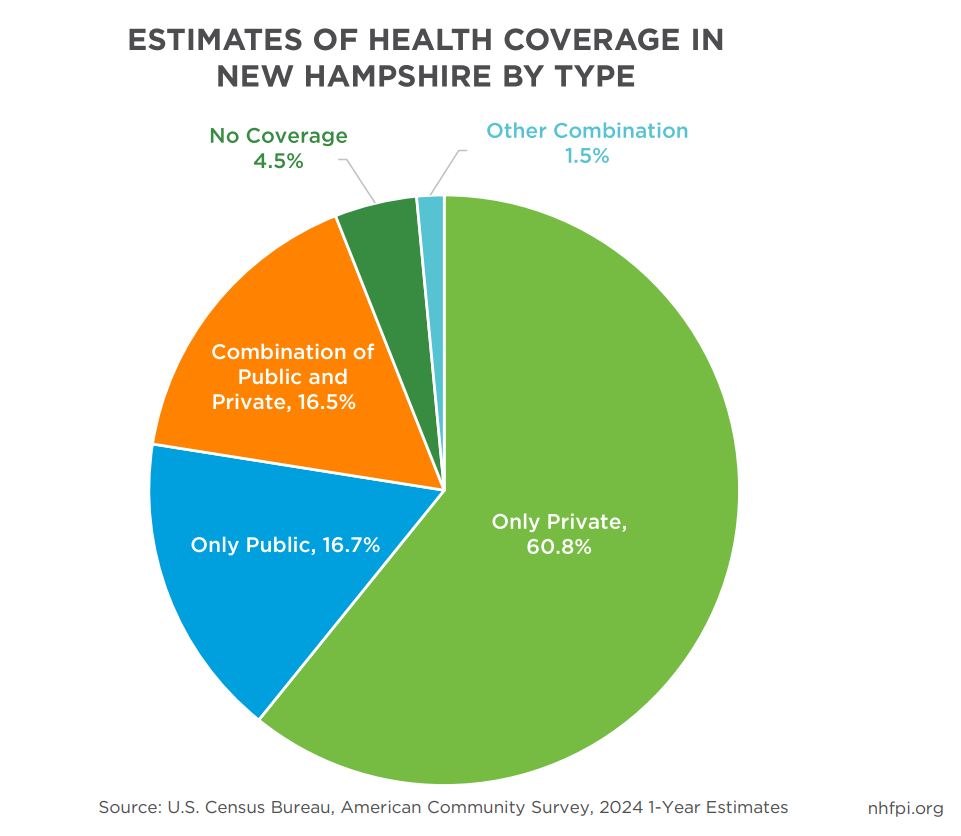
The majority of individuals in the state reported having private insurance (60.8 percent), while the remainder reported having public only (16.7 percent), a combination of public and private (16.5 percent), another combination (1.5 percent), or no insurance coverage (4.5 percent). The rate of Granite Staters without health insurance remained stable between 2023 and 2024.
The rate of uninsured Granite Staters remained stable despite changes to COVID-19 era federal provisions related to Medicaid, a state-federal partnership that provides health coverage to adults and children with low incomes, individuals with certain disabilities or with long-term care needs, and other specific populations. In 2023, one in seven Granite Staters were enrolled in Medicaid.
During the COVID-19 pandemic, the federal continuous enrollment provision allowed Granite Staters to retain Medicaid coverage throughout most of the public health emergency without verifying their continued eligibility. The provision’s repeal, known as “Medicaid unwind,” began in March 2023 and resulted in a 26.7 percent decrease in beneficiaries by April 1, 2024, one year later.
New Hampshire’s 2024 uninsured rate is lower than the pre-pandemic rate of 6.3 percent in 2019 and pandemic era rate of 5.9 percent in 2021. The net increase in insured Granite Staters may have resulted from the Medicaid continuous enrollment provision increasing use of public coverage as well as enhanced subsidies for purchasing private insurance through the individual health insurance marketplace established by the Affordable Care Act, which have been available since 2022. Even with the decrease in the uninsured rate since pre-pandemic rates, approximately 62,000 Granite Staters did not have health insurance coverage in 2024.
Future changes to health care policy, including work requirements authorized by both the federal government and the New Hampshire Legislature, increased premiums for individuals and families covered by Medicaid, and the loss of enhanced subsidies for coverage purchased through the individual marketplace may result in higher uninsured rates in 2025 and 2026.
Nearly Half of Granite State Renters Are Cost-Burdened By Housing Costs
A limited supply of housing units in New Hampshire is contributing to both higher rental costs and increased sale prices for single-family houses across the state, making purchasing a home, and associated wealth-building opportunities, more difficult to access for those who currently rent.
In 2024, the estimated median income for households that owned their home was $119,152. Renters’ median household income that same year, however, was estimated to be $58,715, about half of the median income of owner households.

Lower incomes increase the likelihood of being cost-burdened by housing costs, including rent and utilities. Cost-burdened is a term the U.S. Department of Housing and Urban Development has used to describe households that pay more than 30 percent of their income toward housing. In 2024, approximately 49 percent of renters met the criteria of being housing cost-burdened compared to about 28 percent of owner households paying a mortgage and about 20 percent of owner households without a mortgage.
Other Key Data
Beyond these topline numbers, about 13 percent of workers age 16 and over commuted out of state for employment, while about 16 percent worked from home. Income inequality, as measured by the Gini Index, is not higher than it was just before the COVID-19 pandemic, but is higher than it was in 2010. These data, as well as other information recently provided by the U.S. Census Bureau, provide additional insights into the well-being of Granite Staters.