KEY POINTS
- The New Hampshire Child Care Scholarship Program (NHCCSP) is the State’s primary method for supporting access to early care and education services for families with low and moderate incomes.
- New Hampshire has expanded access to NHCCSP in recent years, but state investment has not kept pace with enrollment growth, increasing reliance on federal funding to sustain the program.
- Potential NHCCSP expansion strategies include increasing provider reimbursement rates, reducing family cost-sharing mechanisms, and widening family income eligibility thresholds.
- New Hampshire has opportunities to strengthen NHCCSP in ways that keep pace with innovations in other states and better reflect the cost of delivery high-quality care.
This report provides an overview of the New Hampshire Child Care Scholarship Program (NHCCSP), its current structure, the opportunities and challenges associated with strengthening the program, as well as a cross-state analysis of policy approaches that may inform considerations for New Hampshire.
The report examines the basic components of NHCCSP, including provider participation, family eligibility and costs, and the program’s federal and State funding structure. It considers key limitations affecting the program, including constrained provider supply, workforce challenges, funding uncertainty, and administrative barriers to access. The report explores policy approaches used by other states that could inform discussions about the future of NHCCSP, including expanding family income eligibility, modifying family cost-share structures, increasing, and targeting provider reimbursement rates, revising cost-of-care methodologies, strengthening program administration and governance, and developing sustainable funding mechanisms.
Together, these sections provide context on the current NHCCSP and highlight a range of policy considerations for strengthening child care affordability, access, and system capacity in New Hampshire.[1]
Overview of the New Hampshire Child Care Scholarship Program
The NHCCSP is the State’s primary child care assistance program. In July 2026, this program connected 5,851 eligible children with a provider to access early care and education services in New Hampshire, helping families afford child care by limiting required payments and directly funding child care centers and other providers.[2] While NHCCSP directly benefits participating families, expanding access to affordable child care also supports employers, strengthens labor force participation, and benefits the broader state economy. Research suggests that New Hampshire’s child care shortage may have cost businesses up to $56 million in lost revenue and State and local governments up to $14 million in tax revenue during 2023.[3] This report examines how other states have strengthened and expanded their child care subsidy programs and considers how these approaches could inform policy options to strengthen NHCCSP and make child care more affordable to Granite State families.
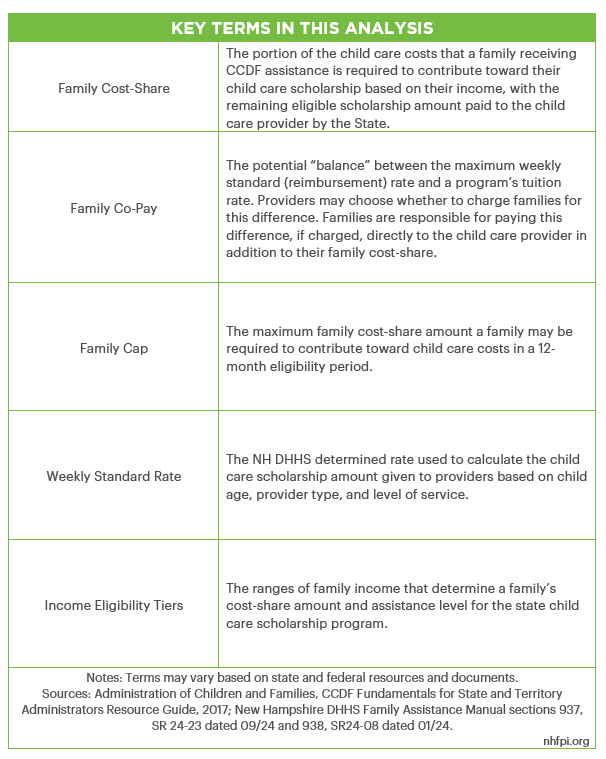
The NHCCSP is funded through a combination of federal Child Care and Development Fund (CCDF) dollars and State resources. The program operates by having the New Hampshire Department of Health and Human Services (DHHS) make payments directly to participating child care providers on behalf of eligible families, while families are assigned a cost-share amount based on income. The program is designed to support parents’ participation in work, education, or training activities by reducing the cost of child care services.[4]
Provider Participation and Eligibility
Providers offering child care services who are interested in serving families enrolled in NHCCSP may opt into the program through an enrollment process where DHHS determines eligibility.[5] To participate, providers must meet the following criteria:
- Be 18 years of age or older,
- Meet the definition of either licensed or license-exempt,
- Maintain liability insurance or provide a disclosure to parents that the program is uninsured, and
- Complete all required trainings.[6]
Once approved, participating providers receive payments through DHHS billing services for children enrolled in NHCCSP. These payments are based on the program’s Weekly Standard Rates, commonly referred to as provider reimbursement rates, which represent the maximum amount the State will reimburse providers for eligible children receiving child care assistance.[7]
Reimbursement rates vary based on factors including the child’s age, provider type, licensing status, and level of service. The two primary provider types are either center-based or home-based care, and the level of service differentiates between full-time and part-time care. For example, reimbursement rates for full-time children or infants and toddlers are typically higher than school age or part-time children. Additionally, some license-exempt center-based providers may not be eligible to receive reimbursement for children under age 6.
NHCCSP reimbursement rates are established using a market rate methodology informed by the State Market Rate Survey, which collects information on child care prices charged by providers statewide. Payments are limited to the established State reimbursement rate or the provider’s charge, whichever is lower. Families may also be required to contribute a cost-share based on their income, which is applied toward the cost of care.[8]
Family Eligibility and Costs
Family eligibility for the NHCCSP is based on several components:
- Children must be New Hampshire residents, reside with a parent, legal guardian, or caretaker relative, and be under age 13 (under age 17 if they have a disability).
- Parents or caregivers must also meet eligibility requirements, such as being employed, participating in education or training, or seeking employment, with certain exceptions established in statute and administrative rules.
- Household income is measured against State-established eligibility thresholds based on family size and State Median Income (SMI).
- Eligible families may choose from eligible New Hampshire child care providers.[9]
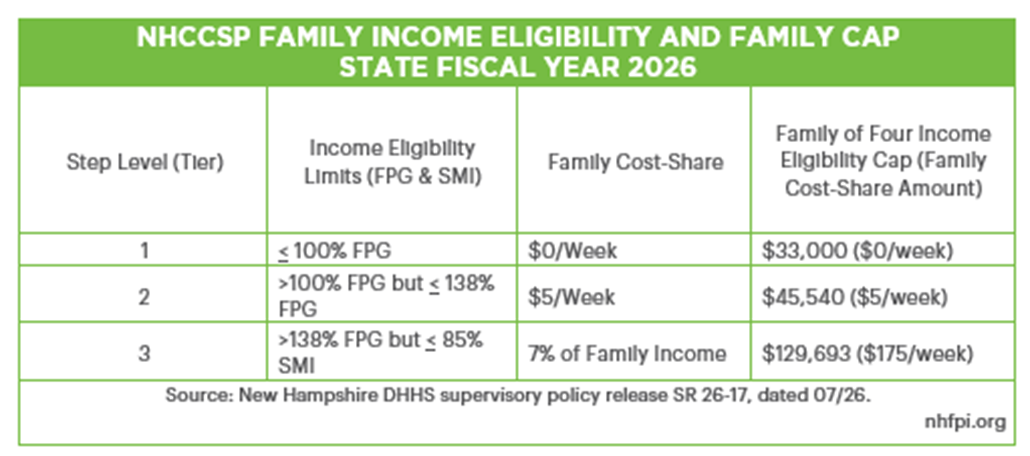
Families receiving NHCCSP assistance may also be required to contribute toward the cost of care services through a family cost-share.[10] This cost-share, representing the family’s financial responsibility for care, is determined using a three “Tier”-scale structure intended to maintain affordability. Families with incomes at or below 100% of the federal poverty guidelines (FPG) have no required cost share, while families between 100 and 138% FPG pay a $5 weekly amount and families with an annual income between 138% FPG and 85% SMI have their total child care cost-share expenses capped at no more than 7% of family income.[11]
Through this multifaceted approach, the program serves as both an early childhood support and a financial support, helping families access care while supporting labor force participation and provider stability.
Beginning in 2024, New Hampshire implemented a series of changes to the Child Care Scholarship Program, which were originally enacted through the State Fiscal Years (SFYs) 2024-2025 budget.[12] One notable change that had significant impact was increasing the maximum income eligibility threshold for new applicants from 220% FPG to 85% of SMI, substantially expanding affordability for moderate-income families. Prior to this change, in 2022, a family of four had to earn less than $69,375 to be eligible for assistance, but the expansion increased eligibility to families of four with up to $102,698 in annual income.[13] The reforms also reduced family out-of-pocket child care expenses by capping cost-shares at 7% of household income and increasing reimbursement rates paid to participating providers. These changes may help improve child care affordability, strengthen labor force participation, and expand access to child care services across the state.
NHCCSP Funding Mechanism
The NHCCSP is funded through the CCDF, the primary federal-state financing mechanism authorized under the Child Care and Development Block Grant (CCDBG) Act. New Hampshire’s CCDF allocation consists of five funding streams: federal discretionary, mandatory, and matching funds, supplemented by required State matching and maintenance of effort (MOE) contributions. Together, these resources support the NHCCSP implementation and delivery, as well as other ECE-related administrative costs. These funding sources also support some quality improvement initiatives, including Granite Steps for Quality (GSQ), which is the State’s Quality Recognition and Improvement System. In SFYs 2026-27, the NHCCSP had a total of $89.7 million in appropriated funds, with approximately 27% from State General Fund dollars. During periods of increased demand, such as during the 2024 NHCCSP expansion initiative, federal guidelines permit the State to transfer up to 30% of Temporary Assistance for Needy Families (TANF) funds to help sustain scholarship availability as prevent potential waitlists.[14] While the State has not experienced a waitlist for NHCCSP since SFY 2011, the growing number of children enrolled in NHCCSP in recent years places excise strain on available resources and could result in a funding bottleneck.[15]
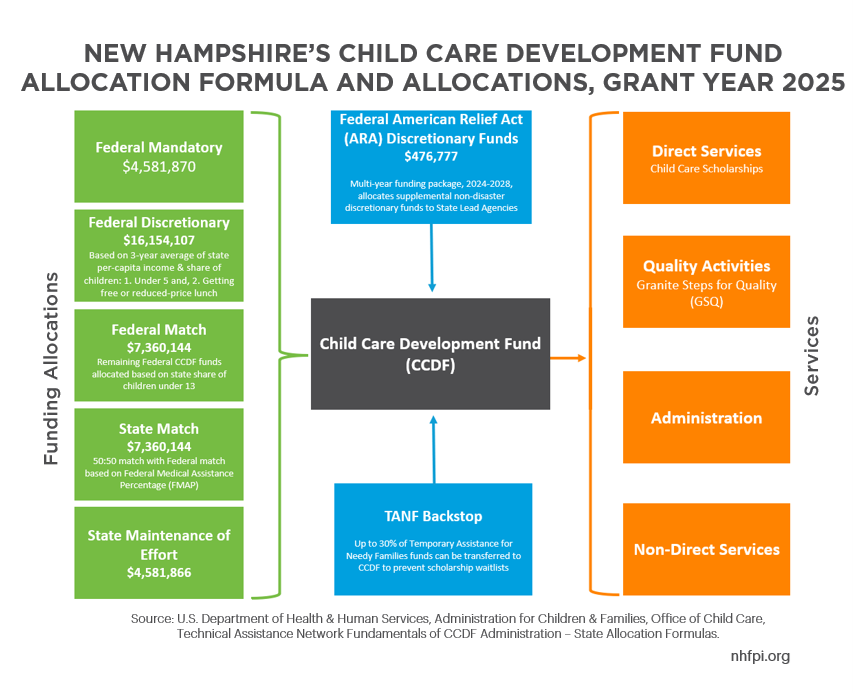
Although the CCDF provides the primary federal funding source for the NHCCSP, the State investment primarily derives from State General Fund appropriations and, in recent years, temporary federal relief funding to support its overall investment. State General Funds are used to satisfy CCDF State match and MOE requirements and to finance program expansions beyond what federal funds alone can support. However, from SFY 2020-21 to SFY 2026-27, State General Fund appropriations for ECE services declined by 11%, including a 19% reduction in funding for NHCCSP, while reliance on federal funding increased by 62%. Additionally, during and following the COVID-19 pandemic, New Hampshire also received approximately $145.9 million in one-time federal relief funding, supplemented by $15 million in State funding to support the ECE workforce. These temporary investments enabled the State to stabilize providers, expand scholarship access, and strengthen the delivery of child care services, but much of those funds have since been exhausted.[16]
Scholarship Program Limitation and Opportunities for Improvement
While most children enrolled in the NHCCSP are connected to a provider, a substantial number of families that have gone through the eligibility process and successfully enrolled are not. Many other children are likely eligible, based on the incomes of their households, but are not enrolled at all. Analysis conducted by the University of New Hampshire’s Carsey School of Public Policy found that in the Fall of 2024, approximately 55,000 children were potentially eligible to enroll in NHCCSP and from May 2025 to April 2026, there was an average of 553 children per month that were enrolled but not connected to a provider. Furthermore, an estimated 14,801 children do not qualify because their family income exceeds current 85% SMI eligibility limits, despite living in households with incomes below the state median and meeting all other criteria to be otherwise eligible. The gaps between the number of children enrolled in the NHCCSP, those successfully connected with a provider, and those who remain eligible but unenrolled, highlights both growing demand and persistent structural constraints within the state’s child care system.[17]
Provider Supply Challenges
In recent years, the number of licensed providers has declined, placing excess strain on the supply of care across the state. Analysis of DHHS administrative licensing data conducted by the Carsey School found that from 2017 to 2025 the number of licensed provider programs declined by 16%, driven largely by the loss of home-based providers (37% decrease), which has further limited the system’s ability to absorb increased demand and may disproportionately affect rural communities that have historically faced greater affordability and access challenges. Furthermore, during this same period, the number of licensed slots among providers increased, indicating a consolidation of providers into fewer, larger child care centers.[18]
These supply constraints coincide with workforce shortages, as the state’s child care workforce declined by 6% between 2023 and 2025, representing a loss of approximately 330 educators and staff. Therefore, sustaining and expanding access depends not only on supporting families financially, but also on strengthening the infrastructure and workforce necessary to deliver care.[19]
Constrained Funding
Although enrollment in NHCCSP increased substantially following the program’s expansion in early 2024, public investment from the State’s locally-sourced revenues has not kept pace since that time.[20] Two years following the early months of expansion implementation from December 2023 to December 2025, the three-month average number of children enrolled rose by 82%, while average State General Fund expenditures per child increased by only 11%. Furthermore, between SFYs 2023 and 2026, State General Fund appropriations for the NHCCSP declined by 2%.[21]
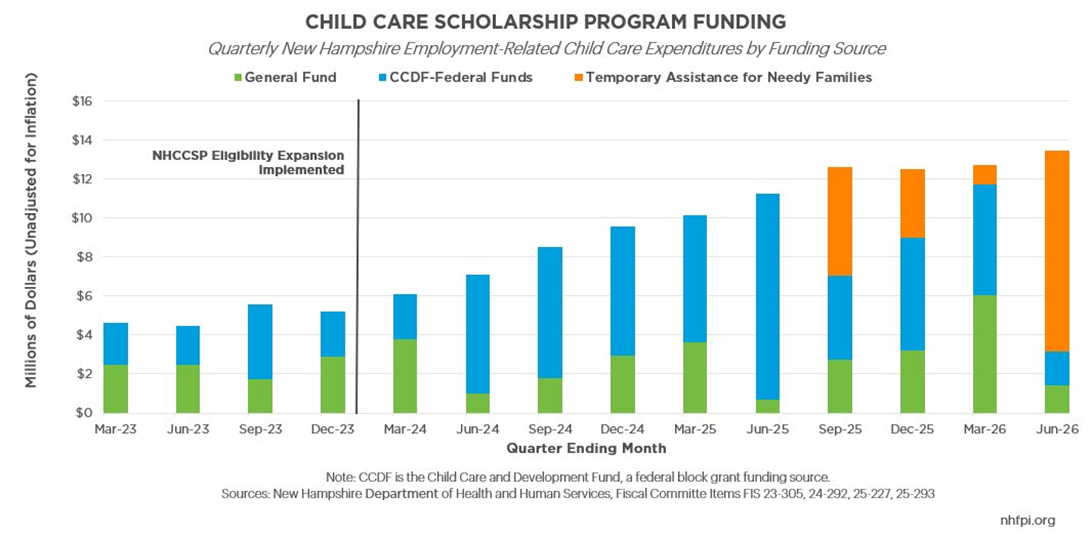
To maintain services and avoid a waitlist for families to begin receiving assistance through NHCCSP, the State began relying on TANF funds during the second half of 2025. However, due to federal and State restrictions that limit the share of TANF resources available for child care, there remains additional uncertainty about the program’s long-term financing. As DHHS has expressed concern about sustaining current service levels through the remainder of the biennium, additional State General Fund investments may be necessary to prevent future waitlists and provide greater stability for both families and providers.[22] Greater funding certainty could also support initiatives aimed at recruiting and retaining early childhood educators and expanding provider participation.[23]
Other Limitations on Access
Beyond funding challenges, both families and providers face administrative and operational barriers that may limit the program’s effectiveness. Carsey School research found that nearly half of surveyed New Hampshire families had never heard of NHCCSP, while others reported uncertainty about eligibility and difficulties navigating application requirements and paperwork.[24] National research has identified that additional barriers to child care subsidy enrollment include transportation constraints, work schedules, language differences, and stigma, which may further impede participation.[25]
Providers may experience similar burdens, particularly smaller and home-based programs with limited administrative capacity. Despite increased reimbursement rates, approximately one in five licensed providers do not participate in NHCCSP, and many participating providers continue to face rising operating costs that exceed reimbursement levels.[26]
Lessons and Policy Considerations from Other States
This section highlights policy approaches and implementation strategies that states have used to strengthen their child care subsidy programs. While these examples are not modeled as specific proposals for New Hampshire, they provide insight into how other states have improved affordability, strengthened provider participation, enhanced program administration, and better aligned child care assistance with the needs of families and providers. Together, these cross-state examples offer considerations that could inform future discussions about the continued evolution of the NHCCSP. Through the federal CCDF guidelines, states have broad flexibility to design and administer their child care subsidy programs in ways that reflect their unique needs and policy priorities.[27] This flexibility provides New Hampshire with meaningful opportunities to further strengthen the NHCCSP by expanding access, improving affordability, and enhancing the program’s ability to meet the diverse child care needs of Granite State families.
Expanding Family Income Eligibility
While expanding the family income eligibility threshold to 85% of SMI in 2024 increased program access for potential enrollees, the price of child care remains a significant financial burden for many Granite State families.[28]
Federal Eligibility Guidelines and State Expansions
The current New Hampshire 85% income eligibility maximum threshold aligns with federal law that a state’s CCDF federal dollars can only be used for eligible families whose income does not exceed 85% of SMI. However, states are still permitted to raise the maximum family income eligibility amount beyond the 85% limit as long as the dollars used to fund services for families above that income level are from state funding sources only.[29]
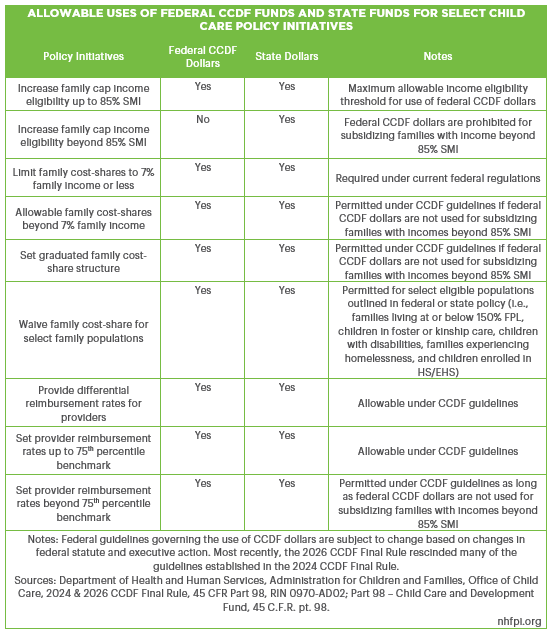
Based on Federal Fiscal Year 2025-2027 CCDF state Plans, only three states, including Maine (125% SMI), New Mexico (400% FPG), and Vermont (575% FPG), offer child care financial assistance beyond the 85% SMI threshold set by Federal Law to receive CCDF state match dollars.[30] In 2025, New Mexico became the first state to eliminate its income eligibility cap entirely, making child care assistance available regardless of family income. New Hampshire is one of 16 states that set their family income eligibility maximum at 85% SMI, while 32 states and the District of Columbia have set the maximum family income eligibility to receive child care financial assistance below 85% SMI.[31]
Research has shown that raising the family income eligibility threshold for receiving financial assistance through child care subsidy programs can serve as a crucial mechanism for mitigating family financial constraints, expanding access to high-quality care settings, increasing maternal labor force participation, and decreasing the rate of children living in poverty.[32]
Potential Granite State Beneficiaries
New Hampshire DHHS set the 85% SMI cap for an NHCCSP eligible family of four at $129,693 annual family income. Nearly half of all Granite State families of four with at least two children under age five have a family income that is less than the DHHS set 85% SMI threshold.[33] Furthermore, the median annual family income for all families with at least one child under age five is approximately $121,654.[34] Relative to State policy, families with income above the 85% eligibility threshold are responsible for paying the full tuition price as listed by the provider.
While the NHCCSP serves as a critical and necessary resource for eligible families, many families in New Hampshire remain ineligible for NHCCSP based on family income. Many of these families may struggle to afford care, as the average annual price in center-based care for an infant was $16,462 and $15,262 for a toddler in 2025.[35] Consequently, some parents, disproportionately mothers, may decide to exit the workforce due to high child care costs. In addition to the costly implications exiting the workforce can have on mothers’ professional advancement opportunities and personal economic security, decreased parental labor force participation in response to increased child caregiving responsibilities can pose significant costs to both businesses and government tax revenue.[36]
In 2024, Maine implemented a series of expansions to its child care subsidy program, Maine Child Care Affordability Program, including raising its family income eligibility cap beyond the prior threshold of 85% SMI and establishing a graduated system of family cost-shares. These initiatives were designed to be phased in annually until they reach their final benchmark in 2030 of a family income eligibility cap of 250% SMI and a 7% family parent fee (Maine’s cost-share) amount. Since implementation in 2024, enrollment has increased by 15%, with the largest gains among preschool-aged children, whose enrollment increased by 53%.[37]
Targeted Aid for Workforce Supports
Expanding access to affordable ECE services through NHCCSP is only possible if there is a sufficient and qualified workforce to provide and deliver services. According to the U.S. Bureau of Labor Statistics, in May 2025, there were 5,450 early childhood educators employed in the New Hampshire workforce.[38] Key research has shown that a main driver of early childhood educators leaving the workforce is a lack of economic security, amongst other indicators including poor psychological well-being, limited workplace supports, and system inequities that strain staff.[39]
Despite New Hampshire early childhood educators having higher levels of education on average than other workers, their median annual earnings are about 66% that of other workers throughout the state.[40] In 2025, New Hampshire implemented a 6-month workforce retention pilot program that made early childhood educators eligible for NHCCSP up to 100% SMI. The program ended after the pilot and has not been made permanent following the pilot program’s expiration.[41]
Other states have pursued more permanent child care subsidy program expansion initiatives targeted at early childhood workforce economic security, including Oklahoma and Kentucky. Similar to New Hampshire, Oklahoma and Kentucky have set their child care subsidy program family income eligibility at 85% SMI. Unlike New Hampshire, however, these two states have opted to waive family income as an eligibility requirement for select groups of early childhood educators. While there are some slight variations in policy design by state, providing financial relief for these families through participation in state government child care subsidy programs can serve as a critical economic incentive for retaining and recruiting a qualified ECE workforce.[42]
Modifying the Family Cost Share Structure
Required family contributions (referred to as a cost-share in New Hampshire), are one of the key components of CCDF-funded child care subsidy program design. In 2024, the cost-share amount for family income was capped at 7% for families covered within the Tier 3 category up to 85% SMI federal threshold. However, in 2026, the federal 7% cap was rescinded, allowing states to set family cost-shares at a higher or lower rate.[43]
Flexibility in Federal Rules
States are permitted by the federal government to set the family cost-share amount beyond 7% for families with incomes above the 85% SMI; however, funding for these families are limited to state dollars, and cannot include federal CCDF funding or state funds dedicated to matching and accessing those federal CCDF dollars. Additionally, states are granted considerable flexibility as to how they choose to phase-in the family cost-share amount. Consequently, the family cost-share component of state child care subsidy programs is one of the more varied design elements of the program as states implement the design that best fits their context.
For example, states have the flexibility to choose from a menu of design options including: whether the family cost-share will be based on a percent of family income or a set dollar amount, frequency of family billing payments (i.e., weekly, biweekly, monthly), cost-share structure (i.e., sliding scale, graduated scale, single category), waiving additional fees for select family types (i.e., foster families, children with disabilities, etc.), and setting cost-share rates based on SMI or federal poverty guidelines (FPG). Given the significant policy considerations, state agencies and policymakers are responsible for determining how to best design their child care subsidy program’s family cost-share structure to meet the diverse needs of their communities.
The “Cliff Effect” and New Hampshire’s Program in Context
While states employ a variety of family cost-share models, state-level research has found that policy strategies that offer more affordable cost-share rates and gradual sliding scales can reduce the impact of what is known as the “cliff effect.”[44] This cliff effect is the scenario when a family’s income exceeds the eligible threshold for either a cost-share tier or maximum income cap amount and the family is faced with a significantly higher payment. For example, a family of four with an infant and a 4-year-old in New Hampshire and an annual income of $120,000, just below the family of four cap threshold of 85% SMI ($129,693), would be eligible for NHCCSP and have their maximum child care payments capped at approximately $8,400 annually, assuming no family co-pay charged by the provider directly. However, if one of the parents received a $10,000 increase in their annual salary through their employer, that would set them just beyond that $129,693 amount, then they may end up paying upwards of $30,000 annually for care at their center-based provider.[45]
New Hampshire is one of four states that sets their family cost-share maximum at exactly 7%; most states (36) have set their maximum at less than 7% of family income, and 10 have set their maximum beyond 7% of family income for those families making above 85% SMI. Many states have also opted to waive cost-shares entirely for certain families, including families experiencing homelessness (21 states), payments for children with disabilities (13 states), or children in foster care (40 states). New Hampshire does not currently waive family cost-shares for any select eligible family type except for families that fall in the Tier 1 category whose income is less than or equal to 100% FPG.[46]
New Hampshire is also one of 40 states that allow providers to charge families enrolled in the state child care scholarship program an amount above the set family cost-share amount to receive services. In New Hampshire, this amount is referred to as the “co-pay,” while the “cost-share” refers to the contribution Granite State families are expected to pay toward the weekly standard reimbursement rate based on their family income (i.e., $0/week, $5/week, 7% family income). Currently, in New Hampshire, the family cost-share model is based on a 3-tier system: Tier 1 families with an income 0-100% FPG do not pay a cost-share amount, Tier 2 families with an income 101-138% FPG pay $5 per week, and Tier 3 families with an income of 138% FPG to 85% SMI pay 7% of their family income. The largest eligibility category by population is Tier 3. For these families making the 85% SMI cap of $129,693, their cost-share amount would be approximately $9,290. Families either on the threshold of the Tier 2 (138% FPG) or the Tier 3 (85% SMI cap), could experience a cliff effect scenario, and face a significant increase in their expected cost-share payments if their income exceeds the eligibility threshold for their Tier. Furthermore, for families on the lower end of Tier 3, making just above 138% FPG, or $45,540 for a family of four, the cost-share amount could have a sizable impact on their ability to afford child care services.[47]
Maine, Minnesota, and Texas
Given the broad flexibility in designing family cost-share structures, some states have employed creative approaches to their child care subsidy programs. For example, many states utilize a sliding or graduated scale for family cost-share amounts, as in Texas, Maine, and Minnesota. The family cost-share amount for eligible Minnesota families sets in once a family’s income meets a minimum of 47% SMI, and then proceeds to increase incrementally in set dollar amounts across a 31-tier (for family sizes ranging from 2 to 8 people) income threshold structure, with each step ranging from approximately $1,000-$5,000 in family income and $2-50 in biweekly cost-share amounts. Alternatively, both Texas and Maine have implemented a family cost-share system based on a percentage of family income that is structured across 10-tiers, with incremental increases in family income accompanied by an increase in the family cost-share amount.[48]
However, Maine and Texas differ in how they set their cost-share entry and exit amounts into the program. The cost-share amount for Texas is capped at 7% for families with incomes at 85% SMI, and there is no waiver for the lowest income families. Maine’s family cost-share can increase to as much as 10% for families making up to 125% SMI, while families with an annual income less than 30% SMI do not have to pay any cost-share amount. Since the expanded cost-share amount exceeds the 7% federal threshold for matched funds, the proportion covered by subsidy is fully funded by state dollars.
Both Texas and Maine employ a cost-share discount for certain families, in which Texas families with more than one eligible child only have to pay the full cost-share amount for their first child and receive a 75% discounted cost-share price for each consecutive child. Instead of a sibling discount, Maine families receive a discounted cost-share based on the quality rated improvement system (QRIS) level of the provider, beginning at a 10% discount for providers with the lowest QRIS rating and increasing to 20% for providers with the highest rating. These cost-share examples reflect the potential variability that exists in how states design and structure their family cost-share models and the degree of flexibility that states are afforded in these policy decisions.
Provider Reimbursement Rate Reform
One key mechanism for reforming child care subsidy programs to better support providers is by adjusting provider reimbursement rates. Key research has found that this policy expansion initiative can be a significant factor in improving provider participation in their child care subsidy program.[49]
Provider reimbursement is the mechanism designed to pay providers participating in their CCDF-funded state child care subsidy program the costs for serving children enrolled in the program.
Setting Reimbursement Rates
Per federal guidelines, states are required to set their provider reimbursement rates based on one of three methods:
- Market Rate Survey (MRS),
- S. Administration for Children and Families pre-approved alternative methodology, or
- hybrid approach that incorporates elements of both.[50]
Similar to other components of CCDF child care subsidy programs, states are afforded broad discretion in the implementation and methodology for setting provider rates and collecting market rate data. States are granted the authority to vary these rates based on geography, provider type (i.e., home-based, family-based, license-exempt, etc.), child age, part-time or full-time enrollment, QRIS rating, provider operating hours, or special populations, such as children with disabilities. Consequently, there is significant variability in how provider reimbursement rates are set, leaving a patchwork of policies for provider administrators and state officials to navigate.
In addition, per the 2024 CCDF Final Rule, all states are also required to account for, “the cost of providing higher quality child care services that were provided…” when establishing payment rates through a “narrow cost analysis.” Although states have broad flexibility in determining the data sources and variables used to determine these provider costs, and the cost analysis findings are intended to help ensure reimbursement rates appropriately reflect differences in the cost of delivering care.[51]
Regardless of whether a state uses a MRS or a federally approved alternative methodology based on a cost model, it must also conduct a narrow cost analysis to satisfy the federal cost analysis requirement. States are also required to update their payment rate methodology at least once every three years, and within two years of submitting a new CCDF State Plan.
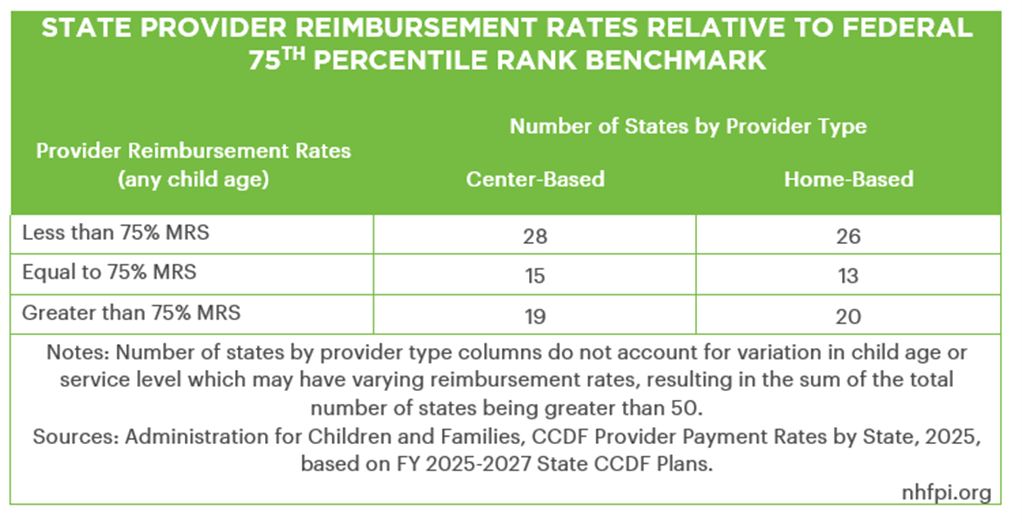
While provider reimbursement rates are intended to help ensure providers are not disadvantaged by serving children enrolled in the state child care subsidy program, due to the fragile economics of operating as a child care provider, reimbursement rates often fall short of covering the true cost of delivering care.[52] Despite the federal recommendation of setting the benchmark provider reimbursement rate to 75th percentile of the state child care market price for all provider types and age of child served, 30 states set their rates for at least one provider type or child age below the 75th percentile. New Hampshire is one of 17 states that set their rates for all licensed provider types and child ages at or above the 75th percentile.[53]
Covering Costs with Market Rates
Although the licensed provider reimbursement rates in New Hampshire meet the 75th percentile child care market price federal benchmark, the State’s decision to utilize a MRS to set reimbursement rates, instead of an approved alternative methodology such as a cost-estimation model, results in a rate based largely on private pay tuition prices providers charge families and not an amount that accounts for the holistic cost of delivering care services.
For example, the State MRS is designed to capture only the tuition price that providers charge families, which are then utilized to calculate the 75th percentile price for the set reimbursement rate based on provider type (center-based, home-based, or licensed exempt providers), child age, and level of service (full-time, part-time).[54] Consequently, the set rates can often fall short of covering the full cost of operating a child care facility, as the calculation does not account for expenses such as staff wages, benefits, and training, in addition to facility maintenance and utility costs beyond the information provided by the tuition amount itself. The reimbursement rate is also set statewide, while there may be significant variations in cost for providers in different regions of the state.
Research has found that the operating costs associated with providing a safe facility and well-compensated qualified staff are essential for the delivery of high-quality care services. Analysis conducted by the Carsey School of Public Policy of select child care providers in New Hampshire found that personnel expenses account for approximately 70% of program expenditures, consistent with literature at the national level.[55] Yet costs associated with high-quality care do not always translate into tuition prices, as providers are constrained to setting tuition prices at an amount that families in their community can afford to pay.[56] Consequently, excluding operating costs from the MRS calculation for provider reimbursement rates could leave providers with insufficient funds for covering costs and disincentivize participation in the scholarship program.
Boosting Provider Reimbursements
States that have opted to employ a MRS for setting their provider reimbursement rates utilize varying strategies when designing their subsidy program to improve provider participation.[57] States have the authority to set their provider reimbursement rates beyond the 75th percentile rank of their respective MRS. As of 2025, approximately 25 states have set their reimbursement rates beyond the 75th percentile rank for at least some providers based on either age of child served or provider type. For example, Oregon set its provider reimbursement rates at the 80th percentile rank, regardless of child age and provider type. Oregon is one of eleven states, including New Hampshire, that have a set reimbursement rate regardless of child age or licensed provider type. Additionally, Oregon child care providers participating in Oregon Registry Step, a program designed to support professional development opportunities for early childhood educators, receive an enhanced reimbursement rate beyond the standard rate amount.[58]
However, most states set provider reimbursement rates that vary depending on the child’s age served and provider type. For example, Missouri set its provider reimbursement rates to the 100th percentile rank for infants and toddlers in both center-based and family child care settings, but set its rates for preschool and school-age children at the 65th percentile rank level. Furthermore, Kansas set its provider reimbursement rates at the 90th and 85th percentile rank for infants and toddlers, respectively, in center-based care settings, but at a lower rate at the 75th percentile rank for all children in family child care settings and preschool-age children.
Targeted Rates by Provider Characteristic
Some states may also set varying reimbursement rates based on provider characteristics, such as whether the provider participates in the state government’s QRIS, the provider’s hours of operation, or whether the provider offers services that meet the needs of children with disabilities.[59]
For example, both Florida and Nevada offer reimbursement rates beyond the standard amount for providers who participate in the state QRIS. Florida, along with many other states, also offers higher reimbursement rates for providers that meet required standards for offering services for children with disabilities. In the case of Florida, providers are eligible to negotiate up to an additional 20% of the standard reimbursement rate if they prove that they offer the appropriate modifications necessary, as outlined in the Americans with Disabilities Act (ADA), to meet the needs of a child with a disability. Lastly, some states, including Kentucky, offer higher reimbursement rates for providers that offer child care services during nontraditional hours or days. Providers in Kentucky that operate between 7pm and 5am on weekdays or on weekends receive an additional reimbursement amount.[60]
New Hampshire also utilizes differential reimbursement rates based on certain child characteristics, including serving children with disabilities. The State provides a $50 to $100 weekly supplement for children with verified disabilities. However, New Hampshire does not provide additional differential rates for other provider characteristics, such as nontraditional hours, infants and toddlers, or school-age programs.[61]
Differential provider reimbursement rate policies set by states based on provider characteristics are a key strategy for incentivizing program participation in the state child care subsidy program and expanding access to affordable care services. By providing enhanced reimbursement for services that are often more costly or less available, such as infant and toddler care, nontraditional hour care, home-based care, or care for children with disabilities, states can encourage providers to offer services that better meet the diverse needs of families.
Effects of Reimbursement Boosts
Research has found that higher provider reimbursement rates can increase provider participation in the subsidy program and improve access to affordable care services for families.[62] Studies have also found that higher provider reimbursement rates have been shown to increase the number of providers offering expanded care services, such as nontraditional hours care, particularly for home-based providers.[63] In addition to expanding access, it is essential that participating providers offer high-quality care services, whether through the state QRIS or recognized national accreditation programs, to ensure that children receive the highest possible standard of care. Recent research suggests that requiring QRIS participation for providers accepting child care subsidy does not reduce the supply of participating providers overall, although administrative burden may remain an impediment to participation for some providers.[64]
Revising Cost of Care Estimation Models
The calculated cost of care is a cornerstone of a state’s child care subsidy program and serves as the primary determinant for setting provider reimbursement rates. Many states have examined their cost of care assessments and revised their methodology to better account not just for providers’ operational costs, but for the true costs of providers offering high-quality care services.[65]
Due to the variety of factors child care providers must consider when setting the prices, determining the actual cost of care can be more complex than examining prices.
While states are afforded broad authority in designing their child care provider reimbursement policies, federal regulations limit the methodologies used to establish provider payment rates to one of the three aforementioned approaches.
Cost Models and Cost Surveys
Based on analysis of State CCDF Plans, during the 2023 to 2025 period, nine states and the District of Columbia established provider payment rates using a federally approved alternative methodology, while 42 states continue to rely on a MRS. Of those 42 states, 14 have also developed alternative methodologies that have not yet received federal approval to establish payment rates. New Hampshire is among the states that currently establish provider reimbursement rates using primarily a MRS, although State law provides authority to the DHHS to allow for rates to be set through an alternative “true cost of care” mechanism.[66] For states conducting a separate cost analysis alongside a MRS, provider costs are most commonly estimated using either a provider cost survey or a cost model. A provider cost survey estimates the cost of care by collecting providers’ reported expenditures on personnel, facilities, operations, and other business expenses. A cost model estimates the expected cost of providing care by applying standardized assumptions about staffing, compensation, enrollment, facilities, and other resources needed to operate a financially sustainable program that meets licensing or quality standards.[67]
The distinction between a MRS and an alternative methodology, such as a cost estimate model, is significant when determining provider payment rates. A MRS establishes reimbursement rates based on the prices providers charge families and reflects existing market conditions, including local supply, demand, and families’ ability to pay for care. While a MRS provides important information on market prices, these rates may not fully capture the resources necessary to deliver financially sustainable, high-quality care, particularly if providers are operating under financial constraints or making spending tradeoffs to remain affordable for the families they serve.[68]
Key research has found a notable gap between the price families pay for tuition and the cost of delivering that care. In contrast, a cost model estimates provider reimbursement rates by combining provider data with established expense assumptions about staffing, compensation, facilities, and program operations to determine the expected cost of delivering care that meets higher quality standards.[69] As a result, cost models are often viewed as providing a more comprehensive approach to rate setting by estimating the “true cost of care” and resources necessary to support both high-quality services and the long-term financial sustainability of child care providers. However, a cost model based on current conditions may not fully capture the additional costs associated with expanded or strengthening the child care system, such as increased worker compensation and benefits, investments in quality, or other facility costs needed to support expanded access. Establishing provider payment rates that account not only for adequate care based on what providers can afford to charge families, but also the highest standard of quality care is essential to ensuring accessible care services for all families.
There are a variety of established models and resources for states to reference when exploring an alternative methodology using a cost estimate model.[70] For example, while Minnesota, South Carolina, and Washington all employ a cost estimate model for setting their provider payment rates that moves away from an emphasis on traditional market prices, their processes and design differ slightly to better align with their state context.[71]
Minnesota’s model was established based on an existing framework derived from the Provider Cost of Quality Calculator that was adapted using state data to then estimate costs across provider types, child age groups, quality levels, and geographic regions, and prioritizes long-term provider financial sustainability. Alternatively, South Carolina developed a provider-focused cost survey to better inform the assumptions of its cost model specific to provider operating costs. Lastly, Washington’s model combined a traditional MRS with its cost model and was developed with the focus on establishing provider rates that met the full cost of delivering high-quality care, and placed greater emphasis on personnel costs, such as living wages and benefits.[72]
Enhancing the Program’s Administrative and Governance Structure
The effectiveness of child care subsidy programs in delivering accessible and affordable care for families depends not only on program policies, but also on the governance and administrative systems responsible for implementing them. States have the flexibility to reform these systems by improving coordination across agencies and streamlining early childhood programs, which can strengthen service delivery, reduce administrative fragmentation, and better support families and providers.
The delivery and implementation of high-quality ECE are predicated on state systems that are responsible for the governance and administration of the various programs that fall under the early childhood umbrella. These programs include, but are not limited to, child care subsidy, child care state licensing, QRIS, state-funded preschool, early intervention services, home visiting, child nutrition, Head Start/Early Head Start, as well as others.
Consolidating Management
Despite the existence of these varied programs, which are designed to support the holistic development and well-being of children, their placement within state government structures varies widely. In some states, these programs are housed across multiple state agencies and departments, creating a fragmented early childhood system. As a result, programs that could benefit from greater coordination with related services may remain siloed, with differing approaches to implementation and administration. This fragmentation can contribute to inefficiencies in the delivery of early childhood programs and services.[73]
In response to this concern, and in an effort to strengthen efficiencies in ECE programs and service delivery, 14 states have created a dedicated state department focused on early childhood. However, New Hampshire represents one of the 36 states that has not yet taken this initiative.[74] Key research has found that states that pursued the initiative to consolidate and streamline their delivery of early childhood services, including ECE, through governance restructuring into a single entity saw increased administrative and fiscal efficiencies as agencies were no longer competing with each other, improved service delivery processes and data systems, strengthened coordination in advancing early childhood program and policy initiatives, amongst other efforts.[75]
New Hampshire’s Early Childhood Programs
In New Hampshire, early childhood-related programs and services are dispersed across two departments and seven divisions. These programs include: Healthy Families America (Maternal Infant Early Childhood Home Visiting), Women, Infants, and Children Nutrition Program (WIC), GSQ, Head Start Collaboration Office, Financial Assistance to Needy Families (FANF), Supplemental Nutrition Assistance Program (SNAP), Child Support, Medicaid, Children’s Health Insurance Program (CHIP), Child Care Licensing, Birth-to-Three (early intervention services), Child Protective Services, Child and Adult Care Food Program (CACF), and NHCCSP. While NHCCSP, GSQ, and Head Collaboration Office operate under the same State entity (Bureau of Child Development and Head Start Collaboration), there are a total of ten State government entities that directly oversee the aforementioned fourteen early childhood programs.[76]
Not included on this list of New Hampshire programs, but listed for most states, is a state-supported preschool program, as New Hampshire remains one of five states nationally that does not have a state-funded preschool program in place. Indiana is the only state whose preschool program has a parental work or school requirement.[77] Although New Hampshire does not currently have state-funded preschool program, research has found that consolidated and coordinated early childhood programs that better align with the state’s K-12 education system can facilitate smoother and more successful transitions for children as they move from ECE settings into elementary school.[78]
Ensuring New Hampshire’s early childhood programs, including NHCCSP, align is essential to supporting positive outcomes for Granite State children and families. These efforts could strengthen New Hampshire’s capacity to support future expansion of the NHCCSP while reducing fragmentation across administrative and service delivery systems, particularly in data systems, program outreach, and provider and family application support.
Examples of Dedicated Agencies
States such as Georgia and Kansas have established dedicated early childhood agencies or departments to oversee a broad range of programs. These dedicated agencies have supported efforts to improve efficiency and coordinated delivery of care services.
Georgia became the first state in the nation to do so with the creation of the Department of Early Care and Learning (DECAL) in 2004, and most recently, Kansas with the establishment of a statewide Office of Early Childhood in 2026. Georgia’s DECAL was designed to unify the state’s ECE initiatives under a single mission and now directly oversees the state’s child care licensing, child care subsidy program, QRIS, state-funded preschool program, Head Start, and CACFP.
Similarly, the Kansas Office of Early Childhood consolidated nearly 20 early childhood services and programs across multiple agencies under a single governance structure, including their home visiting services, child care subsidy program, QRIS, Head Start, and child care licensing. Interviewed Kansas agency staff expressed enthusiasm for the state’s new governance model, noting that a more holistic approach to early childhood service delivery could improve coordination, increase funding opportunities, enhance family access to services, and strengthen public-private partnerships.
Conversely, other states have focused on consolidating key early childhood programs within existing state agencies. For example, over the course of 20 years, Virginia has centralized major early childhood functions within preexisting agencies to improve coordination while leveraging existing administrative infrastructure. Virginia has worked to consolidate key early childhood programs, including child care licensing, child care subsidies, and Head Start coordination, into the Virginia Department of Education to create a single point of accountability. These changes have amounted to improved alignment with the K-12 education system, established shared goals across programs, and a more strengthened unified data and program monitoring systems.[79]
Implementation Challenges and Considerations
While expansion of the NHCCSP could provide substantial benefits for Granite State families and children, it also presents significant potential implementation challenges. Any expansion efforts must be accompanied by sufficient investments in administrative capacity and systems infrastructure to support increased program demand and help ensure effective service delivery. Without addressing the existing structural limitations within the NHCCSP, future expansions risk placing additional strain on an already constrained system and undermining the program’s ability to better serve both families and providers.[80]
In addition to administrative capacity challenges, provider capacity must remain top of mind for policymakers when considering strategies to strengthen NHCCSP. Ensuring an adequate supply of child care providers to support scholarship expansion will likely require investments that strengthen provider capacity and improve the quality of early childhood employment. Many providers operate with limited financial margins, restricting their ability to offer competitive wages, affordable health insurance, paid leave, retirement benefits, and other supports needed to recruit and retain educators, as reflected by the 2025 median annual salary of just $37,080 for New Hampshire child care workers.[81]
Beyond administrative and provider capacity, successful expansion may require consideration of New Hampshire’s broader early childhood governance structure. As the State strengthens its early childhood system, policymakers should evaluate opportunities to improve coordination and alignment across programs to further advance and help ensure efficiencies in system delivery and program implementation.
Any efforts to strengthen systems related to the delivery of care must be applied equitably to meet the diverse needs of both New Hampshire’s families and early childhood providers. This includes accounting for differences across provider types, geographic regions, family circumstances, and child care needs to help ensure expanded access translates into meaningful improvements in affordability, accessibility, and quality of care.
Furthermore, policymakers can consider strategies to support families who may remain underserved by NHCCSP expansion, including those who experience eligibility cliffs, remain above income thresholds, or face barriers accessing participating providers. Potential approaches include strengthening public-private partnerships with employers, community organizations, and early childhood providers to develop affordability supports, expand outreach services, and help ensure families who fall outside scholarship eligibility still have pathways to access affordable, high-quality child care.[82]
Lastly, the long-term success of any effort to strengthen or expand NHCCSP will depend not only on policy design but also on the availability of sustainable, dedicated funding. Although recent one-time federal COVID-19 relief funds and temporary state investments provided critical support for New Hampshire’s early care and education system, these resources have now been exhausted. Moreover, state appropriations for early care and education have generally declined in recent years while reliance on federal funding has increased. Without a stable, dedicated state funding source, future efforts to strengthen or expand NHCCSP may prove difficult to implement, sustain, and scale over time amid competing budget priorities and ongoing fiscal uncertainty.[83]
Dedicated funding mechanisms can provide more predictable and transparent resources for early childhood investments, reducing reliance on annual appropriations and helping states sustain program expansions over time. Several states have established dedicated early childhood funds using a variety of revenue sources, including lottery proceeds, tobacco settlement revenues, gaming and sports betting taxes, trust fund earnings, and recurring General Fund appropriations. For example, Georgia has invested lottery revenues into early childhood education since 1992, generating approximately $1.5 billion on average annually to support Georgia’s preschool program and other educational initiatives. Louisiana dedicates a portion of sports betting tax revenues to early childhood education, while Kansas, Kentucky, and Missouri have directed portions of their tobacco settlement revenues toward early childhood investments. More recently, in 2025, Montana established a dedicated early childhood fund supported through interest earnings, demonstrating that states continue to pursue innovative financing approaches to create sustainable funding for young children and families. New Hampshire’s State Constitution limits the use of certain lottery-related revenues for any purpose other than local public schools, but certain new Lottery and Gaming Commission revenues will flow to the General Fund as a result of changes made in the current State Budget.[84]
While these dedicated funding mechanisms support a range of early childhood initiatives, they demonstrate how states have created stable financing structures that can be leveraged to strengthen child care affordability, expand access to ECE programs, strengthen quality initiatives, and invest in system capacity. For New Hampshire, a dedicated ECE fund could provide a flexible financing mechanism to support future NHCCSP expansion, improve administrative infrastructure, and reduce reliance on temporary or one-time funding sources.
Conclusion
State child care subsidy policies from across the country offer a variety of approaches for State policymakers to consider as they evaluate how to strengthen the NHCCSP. Some key strategies include expanding family income eligibility, modifying family cost-share structures, improving provider reimbursement rates, better accounting for the cost of care, strengthening program administration and governance, and establishing more sustainable funding mechanisms. Together, these examples demonstrate the range of policy tools available to address the affordability of child care, strengthen and sustain the early childhood workforce, improve access to care, and help ensure New Hampshire’s youngest residents have a strong start in life.
At the same time, the aforementioned examples from other states demonstrate that any child care subsidy program policy approaches must be considered within the context of each state’s fiscal resources, child care market, administrative capacity, and the needs of families and providers. For New Hampshire, these cross-state examples can help inform discussions about potential approaches to strengthen and expand NHCCSP while recognizing the implementation and funding considerations associated with each. The 2027 Legislative Session will provide the next opportunity for policymakers and other stakeholders interested in addressing the state’s existing child care challenges through legislation. Continued consideration of these policy options, alongside the experiences of families, providers, and other early childhood stakeholders, can help inform efforts to build a more affordable, accessible, and sustainable child care system in New Hampshire.
End Notes
[1] See New Hampshire Department of Health and Human Services, New Hampshire Child Care Scholarship Program landing page.
[2] See New Hampshire Child Care Advisory Council, August 13, 2026 meeting presentation, slide 5, on New Hampshire Child Care Scholarship Program utilization reported by New Hampshire Department of Health and Human Services, Division of Economic Security.
[3] See New Hampshire Fiscal Policy Institute February 2025 Issue Brief, The Economic Impact of the Granite State’s Child Care Shortage.
[4] See New Hampshire Department of Health and Human Services, Child Care Scholarship Enrollment and Web Billing webpage.
[5] See New Hampshire Department of Health and Human Services, 2025 Child Care Scholarship Program Provider Resource Guide.
[6] See New Hampshire Department of Health and Human Services, Licensed-Exempt and Licensed Child Care Programs web pages, accessed August 2026.
[7] See New Hampshire Department of Health and Human Services, Family Assistance Manual, section 937 NH Child Care Scholarship Weekly Standard Rates, dates August 2024, and section 938 Family Cap Amount, dated January 2024, Cost Share and Provider Co-Pay.
[8] See New Hampshire Department of Health and Human Services, State of New Hampshire Child Care Market Rate Study and Narrow Cost Analysis, June 2024.
[9] See New Hampshire Department of Health and Human Services, Family Assistance Manual, section 915 NH Child Care Scholarship Program Criteria, dated January 2024.
[10] See New Hampshire Department of Health and Human Services, Form 2532, July 2025, Child Care Scholarship Income Eligibility Levels. The New Hampshire Child Care Scholarship Program family “cost-share” or amount families are expected to contribute towards the cost of their child care subsidy may also be referred to as a “copayment” or a “family copayment” in federal guidance and other states’ terminology. Throughout this Report, references to “copayments” will be referred to as “cost-share” to align with New Hampshire’s terminology and program definitions.
[11] See New Hampshire Department of Health and Human Services, Family Assistance Manual, section 938, SR 24-08, 01/24, Family Cap Amount, Cost Share and Provider Co-Pay.
[12] See New Hampshire Fiscal Policy Institute’s January 2024 Blog, New Hampshire Child Care Scholarship Eligibility to be Expanded in 2024, Provider Reimbursement Rates Increased.
[13] See New Hampshire Fiscal Policy Institute’s, June 2023, presentation slides, Examining the State Budget: Reviewing the Senate’s Proposal, slide 38.
[14] See New Hampshire General Court, Office of Legislative Budget Assistant, FIS 25-264, Department of Health and Human Services request from Administration of Children and Families, Office of Family Assistance, to authorize use of TANF funds for workforce recruitment and retention grants.
[15] See New Hampshire Department of Health and Human Services, Operating Statistics Dashboard, Table 4.
[16] See New Hampshire Fiscal Policy Institute, February 2024 Fact Sheet, Child Care Funding in New Hampshire and One-Time Federal Investments.
[17] NHCCSP eligibility and enrollment data conducted by the University of New Hampshire’s Carsey School of Public Policy analysis of 2024 American Community Survey 5-year estimates, July 2026; Department of Health and Human Services, administrative licensing data, 2025-26. See also the Carsey School of Public Policy’s February 2025 primer, Reach and Utility of the New Hampshire Child Care Scholarship Program.
[18] Provider supply data conducted by Carsey School of Public Policy analysis of NH DHHS Child Care Licensing Data, July 2017 & October 2025. See also the Carsey School of Public Policy primer Few Providers, Longer Distances: New Hampshire’s Child Care Landscape, September 2024.
[19] See U.S. Bureau of Labor Statistics’ May 2025 & 2023 State Occupational Employment and Wage Estimates for child care workers, child care administrators, and preschool teachers in New Hampshire.
[20] See New Hampshire Fiscal Policy Institute’s June 2026 Blog, Child Care Scholarship Program Faces Structural Limits to Continued Growth.
[21] See New Hampshire Department of Health and Human Services, Operating Statistics Dashboard, Table 4, and General Court of New Hampshire, Office of Legislative Budget Assistant, SFYs 2026-2027 & 2022-2023 Operating Budget.
[22] See New Hampshire General Court, Office of Legislative Budget Assistant, FIS 25-293, Department of Health and Human Services, Fiscal Committee of the General Court, quarterly report on funds expended on employment-related child care services, 2025-26.
[23] See Prenatal-to-3 Policy Impact Center, June 2025 report, Child Care Workforce Retention Incentives.
[24] See Carsey School of Public Policy, March 2023 issue brief, Supportive Program Strengths and Gaps for New Hampshire Families.
[25] See the Urban Institute’s September 2021 report, Assessing Child Care Subsidies Through an Equity Lens and the U.S. Department of Health and Human Services, Early Childhood National Centers, National Center on Parent, Family, and Community Engagement, July 2019 report, Family Outreach Series, Strategies for Outreach to all Families: Overview.
[26] See the Carsey School of Public Policy’s January 2026 issue brief, New Hampshire Child Care Scholarship Program Reaches Young Children Statewide.
[27] See the U.S. Congressional Research Service’s December 2024 Report R47312, The Child Care and Development Block Grant: In Brief.
[28] See the New Hampshire Fiscal Policy Institute’s June 2026 Blog, Annual Price of Child Care for Granite State Children Remains High as Number of Providers Decline.
[29] See U.S. Government Publishing Office, National Archives, Child Care and Development Fund, 45 C.F.R. Part 98, July 1998.
[30] See U.S. Department of Health and Human Services, Administration for Children and Families, Office of Child Care, approved State/Territory CCDF Plans, FY 2025-2027. For specific information by state, see: State of Maine Department of Health and Human Services, Office of Child and Family Services, Child Care Affordability Program; New Mexico Early Childhood Education & Care Department, Child Care Assistance Program; Vermont Agency of Human Services Department for Children and Families, Child Care Financial Assistance Program Income Guidelines.
[31] See the U.S. Administration for Children and Families, January 2025, CCDF Family Income Eligibility Levels by State.
[32] See the Urban Institute’s June 2019 report, What if We Expanded Child Care Subsidies.
[33] For customized data extractions, see IPUMS USA, University of Minnesota, 2020-2024, American Community Survey (ACS) 5-Year Data, U.S. Census Bureau online data tool. The following indicators were used to generate the custom table: Number of householder’s own children under age 5 in household, total family income, state (FIPS code), relationship to household head, and family size. Analysis is limited to families where the child(ren) under 5 are the householder’s own.
[34] For customized data extractions, see IPUMS USA, University of Minnesota, 2020-2024, American Community Survey (ACS) 5-Year Data, U.S. Census Bureau online data tool. The following indicators were used to generate the custom table: Number of householder’s own children under age 5 in household, total family income, state (FIPS code), relationship to household head, and family size. Analysis is limited to families where the child(ren) under 5 are the householder’s own.
[35] See Child Care Aware of America’s May 2026 report, Child Care in America: 2025 Price & Supply.
[36] For research on implications for exiting the workforce has on mothers, see the following sources: U.S. Census Bureau, Center for Economic Studies, April 2025 Report, The Impact of Childcare Costs on Mothers’ Labor Force Participation; Torres A.J.C., Barbosa-Silva L, Oliveira-Silva LC, Miziara OPP, Guahy UCR, Fisher AN, Ryan MK, The Impact of Motherhood on Women’s Career Progression: A Scoping Review of Evidence-Based Interventions, March 2024; and the Urban Institute’s February 2023 report, Lifetime Employment-Related Costs to Women of Providing Family Care. For research on greater economic impact of child care gap, see the following sources: Bipartisan Policy Center, October 2025 article, The Economic Impact of America’s Child Care Gap: Up to $329 Billion Lost Over the Next 10 Years; and the New Hampshire Fiscal Policy Institute’s February 2025 issue brief, The Economic Impact of the Granite State’s Child Care Shortage.
[37] For information on Maine’s Child Care Affordability Program, see the following sources: Maine Department of Health and Human Services, Office of Child and Family Services, Child Care Affordability Program, Full Rule August 2025; Maine Department of Health and Human Services, Title 22: Health and Welfare, Subtitle 3: Income Supplementation, Part 3, Chapter 1052-A, Section 3740-B, 2023; Maine Department of Health and Human Services, Office of Child and Family Services, Early Childhood Education Data Dashboard.
[38] See U.S. Bureau of Labor Statistics’ May 2025 State Occupational Employment and Wage Estimates for child care workers, child care administrators, and preschool teachers in New Hampshire.
[39] See U.S. Department of Health and Human Services, Office of Planning, Research, and Evaluation, March 2024 report, Building and Sustaining the Child Care and Early Education Workforce: Knowledge Review Series.
[40] See U.S. Bureau of Labor Statistics’ May 2025 State Occupational Employment and Wage Estimates for child care workers, child care administrators, and preschool teachers in New Hampshire. Also see, Carsey School of Public Policy, 2024 issue brief, New Hampshire’s Well Educated, Underpaid Child Care Workforce.
[41] See New Hampshire General Court, Chapter 355, Laws of 2024 (Senate Bill 404), “Relative to expanding child care professionals’ eligibility for the child care scholarship program.”
[42] For further details on Oklahoma program, see Oklahoma Partnership for School Readiness, Teacher Recruitment & Retention Program; for details on Kentucky program, see Kentucky Legislative Research Commission, Administrative Regulations, 922 KAR 2:160: Child Care Assistance Program.
[43] For further details on federal CCDF 2024 Final Rule, see U.S. Department of Health and Human Services, Federal Register 89 FR 15366, 45 CFR 98. For further details on 2024 Final Rule recension, see U.S. Department of Health and Human Services, Federal Register 91 FR 207, 45 CFR 98.
[44] For further details on the Cliff Effect, see the following sources: New Hampshire Department of Health and Human Services, Solving the Benefits “Cliff Effect”; the Urban Institute’s 2013 report, Low-Income Families and the Cost of Child Care; U.S. Department of Health and Human Services, Office of Planning, Research, and Evaluation, June 2010 report, Effects of Reducing Child Care Subsidy Copayments in Washington State.
[45] See New Hampshire Department of Health and Human Services, Family Assistance Manual, section 937 NH Child Care Scholarship Weekly Standard Rates and section 938 Family Cap Amount, Cost Share and Provider Co-Pay.
[46] For further details on state CCDF family cost-shares, see the U.S. Administration for Children and Families, January 2025, CCDF Family Income Eligibility Levels by State.
[47] For further details on NHCCSP, see the following New Hampshire Department of Health and Human Services, Family Assistance Manual sections: Section 935, Section 937 (dated August 2024), and Section 938 (dayed January 2024). Data on NHCCSP population eligibility conducted by Carsey School of Public Policy analysis of 2024 U.S. Census Bureau American Community Survey 5-year estimates, July 2026.
[48] For further details on state provider reimbursement policies, see the following sources: Minnesota Department of Children, Youth, and Families, Child Care Assistance Program, Copayment schedules, 2025; State of Maine Department of Health and Human Services, Office of Child and Family Services, Child Care Affordability Program; Texas Workforce Commission, Child Care and Early Learning Program, Parent Share of Cost Sliding Fee Scale.
[49] See the Urban Institute’s 2022 report, Using Child Care Subsidy Payment Rates and Practices to Incentivize Expansions in Supply.
[50] For federal guidance on state methodologies for setting reimbursement rates, see U.S. Department of Health and Human Services, Administration for Children and Families, Office of Child Care, FY 2025-2027 CCDF State/Territory CCDF Plans
[51] See federal CCDF 2024 Final Rule, U.S. Department of Health and Human Services, Federal Register 89 FR 15366, 45 CFR 98.
[52] See the New Hampshire Fiscal Policy Institute’s May 2024 Issue Brief, The Fragile Economics of the Child Care Sector.
[53] See Child Care Technical Assistance Network, Office of Child Care, January 2025 brief, Understanding the 75th Percentile, and Administration for Children and Families, January 2025, CCDF Provider Payment Rates by State.
[54] See New Hampshire Department of Health and Human Services, Family Assistance Manual, section 937 NH Child Care Scholarship Weekly Standard Rates dated August 2024 and the State of New Hampshire Child Care Market Rate Study and Narrow Cost Analysis, June 2024.
[55] For research on operating costs, see the following sources: Backes EP, Allen LR, February 2018, Estimating the Cost of High-Quality Early Care and Education; Carsey School of Public Policy, January 2026 issue brief, Operating on Thin Margins: The Cost of Providing New Hampshire Child Care; Child Care Technical Assistance Network, Office of Child Care, March 2025 report, Guidance on Estimating and Reporting the Costs of Child Care.
[56] See Center for American Progress, March 2023 report, States Can Improve Child Care Assistance Programs Through Cost Modeling.
[57] See BUILD Initiative, November 2022 report, Child Care Rate Setting: Using Cost Data to Inform More Equitable Subsidy Payment Rates.
[58] For further details on Oregon’s provider reimbursement rate policies, see Oregon Department of Early Learning and Care, ERDC Child Care Maximum Rates; see also the U.S. Administration for Children and Families, January 2025, CCDF Provider Payment Rates by State.
[59] For further details on the Missouri and Kansas provider reimbursement rate policies, see the following sources: Missouri Department of Elementary and Secondary Education, Child Care Subsidy Rates and Sliding Fees: Kansas Department for Children and Families, Provider Rate Chart.
[60] For further details on state provider reimbursement rate policies, see the following 2025-2027 CCDF State Plans: Kentucky, Nevada, and Florida.
[61] See New Hampshire’s 2025-2027 CCDF State Plan for details on differential provider reimbursement rates.
[62] See Jonathan Borowsky, Elizabeth E. Davis, 2025, Early Childhood Research Quarterly, Payment rates and the stability of subsidized child care: Evidence from Minnesota’s child care assistance program.
[63] See Wu, Tiffany; Jenkins, Jade; Anamarie A. Whitaker, November 2024, Policy Impacts of Reimbursement Rate Reform: Evidence from the Child Care and Development Fund.
[64] For research on provider participation in child care subsidy programs, see the following sources: Kate Giapponi Schneider, Marji Erickson Warfield, Pamela Joshi, Yoonsook Ha, Dominic Hodgkin, 2017, Children and Youth Services Review, Insights into the black box of child care supply: Predictors of provider participation in the Massachusetts child care subsidy system; the Urban Institute, March 2026 report, Does Requiring QRIS Participation Affect Subsidized Child Care Supply and Use?
[65] See BUILD Initiative, November 2022 report, Child Care Rate Setting: Using Cost Data to Inform More Equitable Subsidy Payment Rates.
[66] See Chapter 79:393, Laws of 2023.
[67] See Child Care Aware of America, June 2026 analysis, Examining the Gaps: Child Care Prices, Costs, and Subsidies.
[68] See Bipartisan Policy Center, June 2020 report, The Limitations of Using Market Rates for Setting Child Care Subsidy Rates.
[69] See Urban Institute, December 2022 report, Using a Narrow Cost Analysis to Inform Payment Rates.
[70] For further details on cost model methodologies, see the following sources: Backes EP, Allen LR, 2018, Transforming the Financing of Early Care and Education; Child Care Technical Assistance Network, Office of Child Care, U.S. Administration for Children and Families, March 2025 report, Guidance on Estimating and Reporting Costs of Child Care.
[71] For further details on state cost modeling strategies, see the following sources: Minnesota Department of Human Services, 2023 Child Care Cost Modeling Report; Prenatal to Five Fiscal Strategies, 2024, Understanding the True Cost of Child Care in South Carolina; Washington State Department of Children, Youth, and Families, Early Educator Design Team Cost of Quality Care Rate Model Recommendations.
[72] See U.S. Department of Health and Human Services, U.S. Administration for Children and Families, Office of Child Care, 2026, Provider Cost of Quality Calculator.
[73] See Education Commission of the States, 2024, 50-State Comparison: Early Childhood Education Governance.
[74] See Prenatal-to-3 Policy Impact Center, Early Childhood Governance.
[75] See Center for American Progress, January 2025 Report, States Seek to Improve Early Childhood Outcomes Through Consolidated Governance Structures.
[76] See Prenatal-to-3 Policy Impact Center, New Hampshire State Governance Structure, Early Childhood Governance.
[77] See National Institute for Early Education Research, The State of Preschool 2025 Yearbook.
[78] For further details on ECE and preschool governance structure, see Megan Rauch Griffard, James Sadler, Michael Little, Lora Cohen-Vogel, 2022, Children and Youth Services Review, Governing early learning among the American states.
[79] For further detail on state ECE governance systems for Georgia, Kansas, and Virginia, see the following sources: Georgia Department of Early Care and Learning, Infusing a Culture of Education: The History of Quality Early Care and Learning in Georgia; Kansas Office of Early Childhood, Prenatal-to-3 Policy Impact Center, April 2025 report, Early Childhood Governance in Kansas; and Prenatal-to-3 Policy Impact Center, August 2025 report, Transforming State Early Childhood Governance: A Case Study, Virginia.
[80] See New Hampshire Fiscal Policy Institute’s June 2026 Blog, Child Care Scholarship Program Faces Structural Limits to Continued Growth.
[81] See U.S Bureau of Labor Statistics’ May 2025 State Occupational Employment and Wage Estimates for New Hampshire.
[82] See Child Care Aware of America, March 2025 report, Public-Private Partnerships for Child Care: Examples and Insights.
[83] For further details on New Hampshire ECE funding, see the following sources: New Hampshire Fiscal Policy Institute, February 2024 fact sheet, Child Care Funding in New Hampshire and One-Time Federal Investments; New Hampshire Department of Health and Human Services, Child Development and Head Start, Child Development Provider Grants.
[84] For further details on Georgia, Louisiana, Kentucky, Kansas, and Montana ECE dedicated funds, see the following sources: Georgia Department of Early Care and Learning, History of Georgia’s Pre-K Program; Louisiana State Legislature, La. Rev. Stat. 17:407.30, Louisiana Early Childhood Education Fund; Kentucky Office of the Attorney General, Attorney General Coleman Announces Kentucky Received $94 Million in Tobacco Settlement Funds, 2026; Kansas Children’s Cabinet and Trust Fund, Children’s Initiatives Fund; Missouri General Assembly, statute 161.215, Early Childhood Development, Education and Care Fund; Montana Department of Public Health and Human Services, HB 924, 2025, Montana Early Childhood Account. For further details on the current New Hampshire State Budget, see the New Hampshire Fiscal Policy Institute’s July 2025 report, The State Budget for Fiscal Years 2026 and 2027.