KEY POINTS
- New Hampshire’s Adequate Education Aid formula considers resident student counts by community, as well as indicators of student needs and local property wealth.
- Municipalities with larger student populations, lower property wealth per pupil, and higher student need are more likely to require State aid beyond the Statewide Education Property Tax (SWEPT), including Extraordinary Needs Grants, Fiscal Capacity Disparity Aid, and Hold Harmless Grants.
- SWEPT changes how State aid is counted across municipalities because the revenue it generates is counted as State education aid even though it is raised and retained locally.
KEY TERMS IN THIS ANALYSIS
These definitions are derived in part from State nomenclature and documents.
- Calculated Student Adequacy Aid is the amount calculated for each municipality based on the students who live there in the education funding formula. This amount includes the base aid for each student and additional differentiated aid for students with specific needs, such as students eligible for free or reduced-price meals, students receiving special education services, and students who are English language learners. This figure does not include aid calculated from community-based factors.
- Adequacy Grant (State Cash) is the amount of State cash provided to a local government based on the amount owed by the State to local governments after the locally-raised Statewide Education Property Tax amount is discounted from the total Adequate Education Aid owed by the State. This amount also includes community-based factors, such as Extraordinary Needs Grants, Fiscal Capacity Disparity Aid, and Hold Harmless Grants, for communities that are eligible.
- Total Adequate Education Aid is the total amount of funding counted as State support for providing an adequate education. This total includes both funding raised through the Statewide Education Property Tax and community-based factors, such as Extraordinary Needs Grants, Fiscal Capacity Disparity Aid, and Hold Harmless Grants.
Public education is administered primarily at the local level in New Hampshire, with local property taxpayers contributing nearly seven out of ten dollars of the total cost of public education. While the State provides funding to local governments, funding for education has been the subject of decades of litigation by local communities suing the State. The New Hampshire Supreme Court has ruled, in several iterative decisions since 1993, that the State government has a constitutional obligation to ensure that students enrolled in kindergarten through grade 12 receive an opportunity for an adequate education that is funded equitably and sufficiently. Most recently, a State Supreme Court decision in July 2025 required additional funding beyond the current structure described in this analysis; however, the Legislature has not increased State funding to comply with the 2025 decision. This Issue Brief explains how current State funding is allocated to local communities through the State’s education funding formula.[1]
The amount of State Adequate Education Aid a municipality is allocated is determined by three major factors: student counts, indicators of student needs, and local property wealth. Each municipality raises its required portion of the Statewide Education Property Tax (SWEPT). The cost of providing an adequate education is calculated in the State’s funding formula. If a community’s SWEPT revenue does not cover that total cost, the State provides additional Adequacy Grants, in the form of a cash transfer from the State, to cover the remaining amount, as well as additional grants based on community characteristics.
This structure means that total State Adequate Education Aid is not distributed evenly among municipalities; instead, it varies according to local conditions. Higher aid may indicate that a municipality has a large student population, that its students require additional services, that its local taxable property wealth per student is lower than certain benchmarks, or that some combination of these factors applies.
Variations in aid per pupil calculations provide another perspective on how aid is distributed. When a community’s per pupil aid is close to the base rate, the community may not have many students who receive free and reduced-price meals, require special education services, or are English language learners.
Together, this information helps to explain why municipalities are allocated different amounts of total State Adequate Education Aid and provides insights into the demographic characteristics of their student populations.
How the State Adequate Education Formula Works
To unpack education funding for local governments, this analysis focused on three sets of calculations from the State’s education funding formula. First is the amount of aid allocated per pupil to a community based on student attendance and characteristics, which is called Calculated Student Adequacy Aid in this analysis. Second is the actual cash paid by the State to local governments after the amount of aid funded by SWEPT is accounted for, which is called the Adequacy Grant. Third is the total amount of aid provided by communities, including the aid calculated on a per pupil basis, aid based on community-level characteristics, and any excess SWEPT, named Total Adequate Education Aid.
New Hampshire’s Adequate Education Aid formula begins with the number of students. The State counts students who reside in each municipality; this count is called Average Daily Membership in Residence (ADM-R). The State uses the previous school year ADM-R to calculate the next State Fiscal Year’s total Adequate Education Aid.[2] The formula assigns a base amount that, under State law until 2026, the State determined a school district would need to provide an adequate education to each student.[3] For State Fiscal Year (SFY) 2027, which encompasses July 1, 2026 through June 30, 2027, the base aid is set at $4,351 per pupil.[4] On top of this base amount, the State provides additional “differentiated” per pupil amounts for students whose education may entail higher costs. A municipality is allocated $2,441 per pupil for the number of students eligible for free and reduced-price meals (FRPM). For students with an individualized education program for special education services (SPED), a municipality is allocated $2,229 per pupil, and for English language learners (ELL), it is allocated an additional $849 per pupil. The State also provides a per pupil amount for home-schooled students who take courses at a public school.[5] As of May 2026, State law was altered to include differentiated aid in the State’s aid to support an adequate education, expanding that total beyond the base per pupil amount.[6]
In the State’s mechanics for determining SFY 2027 aid, there are 148,918 students residing in New Hampshire municipalities for the 2025-2026 school year. The percentages of those students eligible for differentiated aid statewide are as follows:
- 26% qualify for free or reduced-price meals;
- 21% require special education services; and
- 4% are English language learners.
These figures result in a Calculated Student Adequacy Aid distribution, based solely on the number of students and their characteristics relative to the education funding formula, of $817,829,467, which equals $5,492 per pupil.[7] This “total cost of an adequate education,” or Calculated Student Adequacy Aid, is the amount that State lawmakers have required in statute for the State to provide as the obligatory funding amount for adequate education.[8] The calculation differs across municipalities because student populations, and their compositions, vary.
In total, non-SWEPT State Adequate Education Aid accounted for about 17% of school revenue used to support public education in the 2024-2025 school year, while SWEPT accounted for about 9%. Local property taxes comprised approximately 64% of all school revenue, while federal aid and other revenue sources made up only 11%. SWEPT is raised and retained locally, resulting in about $3.0 billion of the $4.2 billion (72%) revenue for public school districts coming from property tax revenue raised from the local tax base.[9]
Distribution of Aid to Municipalities
The median community-level Calculated Student Adequacy Aid, based on student characteristics and not including community characteristics, across all municipalities is $1.28 million, and the median Calculated Student Adequacy Aid per pupil is $5,361. Municipalities with higher numbers of resident students generally receive more Calculated Student Adequacy Aid. For communities with at least one student but fewer than 100 ADM-R, the median Calculated Student Adequacy Aid is about $279,600. It increases to about $1.27 million for municipalities with 100 to 499 ADM-R, and to $4.80 million for municipalities with 500 or more ADM-R. This pattern reflects the structure of the formula: each resident student receives a base grant, and some students receive additional differentiated aid.
The Calculated Student Adequacy Aid per pupil follows a different pattern. Larger municipalities do not necessarily have higher Calculated Student Adequacy Aid per pupil. Municipalities with 500 or more ADM-R have the highest median Calculated Student Adequacy Aid, but their per pupil amount is $5,293, below the $5,416 median for municipalities with 100 to 499 ADM-R. These differences between the total obligation and the per pupil payment show the number of students drives the total amount of aid provided, while the payment per pupil reflects the characteristics of those students and how much they qualify for differentiated aid.

Student need is more directly tied to per pupil Calculated Student Adequacy Aid. Municipalities in the bottom fourth of the differentiated ADM-R share receive a median of $4,930 per pupil, compared with $5,976 for municipalities in the top fourth. Municipalities in the top fourth of differentiated ADM-R share typically have larger shares of students who are eligible for free or reduced-price meals or who receive special education services. Although these municipalities may have lower median enrollment, their higher levels of student needs increase their calculated aid per pupil. As a result, smaller municipalities can receive more aid per pupil even when their total Calculated Student Adequacy Aid remains below that of larger communities.
A community with only a few students who qualify for differentiated aid will have a Calculated Student Adequacy Aid allocation closer to the base amount per student, while a city or town with a higher concentration of students who qualify for FRPM, SPED, or ELL will have a higher Calculated Student Adequacy Aid per pupil because State law allocates additional resources for those students.

For example, Manchester has more than 11,300 ADM-R, with about 55% of students eligible for FRPM, 23% qualifying for SPED differentiated aid, and 19% identified as ELL, which results in a Calculated Student Adequacy Aid allocation of $6,368 per pupil. Nashua has 9,236 ADM-R, with about 47% of students eligible for FRPM, 22% qualifying for SPED differentiated aid, and 18% identified as ELL, with a Calculated Student Adequacy Aid allocation of about $6,136 per pupil.
This pattern also appears in smaller municipalities with concentrated student needs. Franklin, with about 804 ADM-R, has a Calculated Student Adequacy Aid allocation of $6,627 per pupil because about 59% of its ADM-R qualify for FRPM and about 38% qualify for SPED aid. Newport, with about 578 ADM-R, has a Calculated Student Adequacy Aid allocation of $6,531 per pupil and similar differentiated aid concentration percentages to Franklin’s student population. Claremont and Berlin also show higher Calculated Student Adequacy Aid formula allocations per pupil, not only because of their relative size but because their student populations include a higher share of students who qualify for differentiated aid.
How the Statewide Education Property Tax Changes the State Aid Calculation
After the State calculates each municipality’s Calculated Student Adequacy Aid, it subtracts the amount raised through SWEPT.[10] SWEPT is counted as part of total State Adequate Education Aid, as SWEPT is a State revenue source that supports the education funding formula’s allocations, but all SWEPT revenue is raised and retained locally. If SWEPT does not cover the full Calculated Student Adequacy Aid, as is the case for all but 40 municipalities, the community may receive additional non-SWEPT aid from other State revenue sources. This portion of Calculated Student Adequacy Aid is the Adequacy Grant, which is cash from the State that flows from the State to local governments from State revenue raised through means other than SWEPT, such as Lottery and Gaming Commission profits and business taxes.[11]

For SFY 2027, SWEPT is estimated to generate $364 million, slightly above the $363 million target set in law.[12] This SWEPT revenue equals about 34% of total Adequate Education Aid. After SWEPT is accounted for, about $453 million remains in the Adequacy Grant value before any Extraordinary Needs Grants, Fiscal Capacity Disparity Aid, and Hold Harmless Grants are added.[13]
Accounting for SWEPT changes the per pupil aid picture. Manchester’s gross calculated allocation without SWEPT is $6,368 per pupil for SFY 2027. Its SWEPT amount is $1,723 per pupil. Its remaining calculated Adequacy Grants, cash aid after SWEPT, total $4,645 per pupil. Nashua’s gross Calculated Student Adequacy Aid is $6,136 per pupil; the SWEPT amount is $1,951 per pupil, and the remaining Calculated Student Adequacy Aid after SWEPT is $4,186 per pupil. Claremont’s gross calculated student Adequacy Aid is $6,216 per pupil, while the amount raised locally through SWEPT is $1,098 per pupil, and the remaining calculated Adequacy Grant after SWEPT is the equivalent of $5,118 per pupil. These municipalities require additional State Adequacy Grants, cash transfers from the State, because their SWEPT amounts do not cover the amounts the State owes those communities according to the Adequacy Aid formula.
A different pattern appears in municipalities with high property values and relatively few resident students. New Castle has 34.5 ADM-R and $47,817 in SWEPT per pupil, compared with a calculated State Adequacy Aid of $4,591 per pupil through the education funding formula. Moultonborough has 429.8 ADM-R and $17,222 in SWEPT per pupil, compared with a calculated State obligation of $5,401 per pupil if the Calculated Student Adequacy Aid formula operated independently of SWEPT. Waterville Valley has 34.7 ADM-R and $21,323 in SWEPT per pupil, compared with a calculated State education funding formula obligation of $4,934 per pupil. In these municipalities, high State aid per pupil is driven by SWEPT, rather than by additional non-SWEPT Adequacy Grants. Their high per pupil aid levels reflect high property wealth and small student counts, not necessarily higher student need, because of the excess amount of SWEPT revenue generated by high local property values beyond the amount of money the State owes the community through the education funding formula.
Municipalities Receiving Additional Targeted Aid
The education funding formula provides most aid on a per pupil basis and based on student characteristics, but those are not the only factors in determining the amount of aid directed to communities through the State’s education funding formula. The Calculated Student Adequacy Aid based on pupils in public school districts is expected to generate $817.8 million in State aid during SFY 2027, but total Adequate Education Aid will be about $1.062 billion. About $216.2 million of that $244.4 million difference is due to additional aid provided on the basis of community characteristics, including taxable local property wealth relative to student populations.[14] The $28.2 million of the $244.4 million difference comes from excess SWEPT which the local governments retain.

The Extraordinary Needs Grant increases aid for municipalities with lower property wealth relative to the number of students eligible for free and reduced-price meals. The formula uses equalized valuation per FRPM ADM-R (EVFRP), which represents the taxable property wealth in a community per student living in a household with a low income. Municipalities with lower EVFRP receive larger grants, while municipalities with EVFRP above the upper threshold receive no grant. The 66 municipalities receiving Extraordinary Needs Grants have a median EVFRP of approximately $4.7 million, compared with approximately $45.1 million for SWEPT-only municipalities that have at least one FRPM-eligible student. Of the 66 municipalities, the median Extraordinary Needs Grant is approximately $2,015 per pupil, and their median final State aid is approximately $9,116 per pupil.[15]
Fiscal Capacity Disparity Aid is based on property wealth per resident ADM-R, or equalized valuation per pupil. This measure reflects taxable property wealth relative to the base ADM-R count used in the formula. Municipalities with lower equalized valuation per ADM-R receive more aid. The 34 municipalities receiving Fiscal Capacity Disparity Aid in SFY 2027 have a median equalized valuation per ADM-R of approximately $1.4 million. Their median Fiscal Capacity Disparity Aid is approximately $320 per pupil. Their median Adequacy Grant, which is the cash from the State after the amount raised locally by SWEPT is removed, is approximately $8,885 per pupil, as these municipalities often also receive other grants or have larger gaps between Calculated Student Adequacy Aid and SWEPT revenue.
These two forms of targeted aid, Extraordinary Needs Grants and Fiscal Capacity Disparity Aid, will be capped for the largest communities in the state. In municipalities with more than 5,000 resident students, the total amount of Extraordinary Needs Grants and Fiscal Capacity Disparity Aid combined would be limited to $3,750 per student. Currently, only the cities of Nashua and Manchester exceed 5,000 resident students, and only Manchester is projected to be impacted, with a reduction of about $10 million in SFY 2028, based on projections from 2025.[16]
Hold Harmless Grants work differently than the other two forms of community-based aid. These grants are not based directly on current property wealth or current student need. The grants are based on a combination of aid provided to communities in earlier iterations of the education funding formula, in some cases based on data more than 15 years old. Hold Harmless Grants are added after the other components of total Adequate Education Aid are calculated. For SFY 2027, the Hold Harmless Grant will equal 80 percent of the SFY 2025 Hold Harmless Grant amount for each community, and no Hold Harmless Grant is awarded when the locally raised SWEPT amount exceeds the State’s obligation to a community under the education funding formula. Municipalities allocated SFY 2027 Hold Harmless Grants have a median Hold Harmless Grant amount of about $571 per pupil.[17]
Adequate Education Aid Over Time
Since at least 2007, the State and local shares of funding for public education have diverged. In the 2007-2008 school year, total Adequate Education Aid accounted for 34.9% of school revenue, while local property taxes provided 54.1%. By 2024-2025, the share provided by total Adequate Education Aid has fallen to 25.6%, while the local property tax share increased to 63.5%.
This change has resulted in local property taxes, not including SWEPT, funding nearly two-thirds of revenue for local public education. One reason the State’s share of support for public education has fallen is the structure of SWEPT. SWEPT is counted as part of total State Adequate Education Aid, although it is raised and retained locally. The total amount required to be raised through SWEPT each year is set at $363 million. That amount is not adjusted for inflation, meaning that it does not increase each year to keep pace with rising prices, wages, or other education costs.[18]
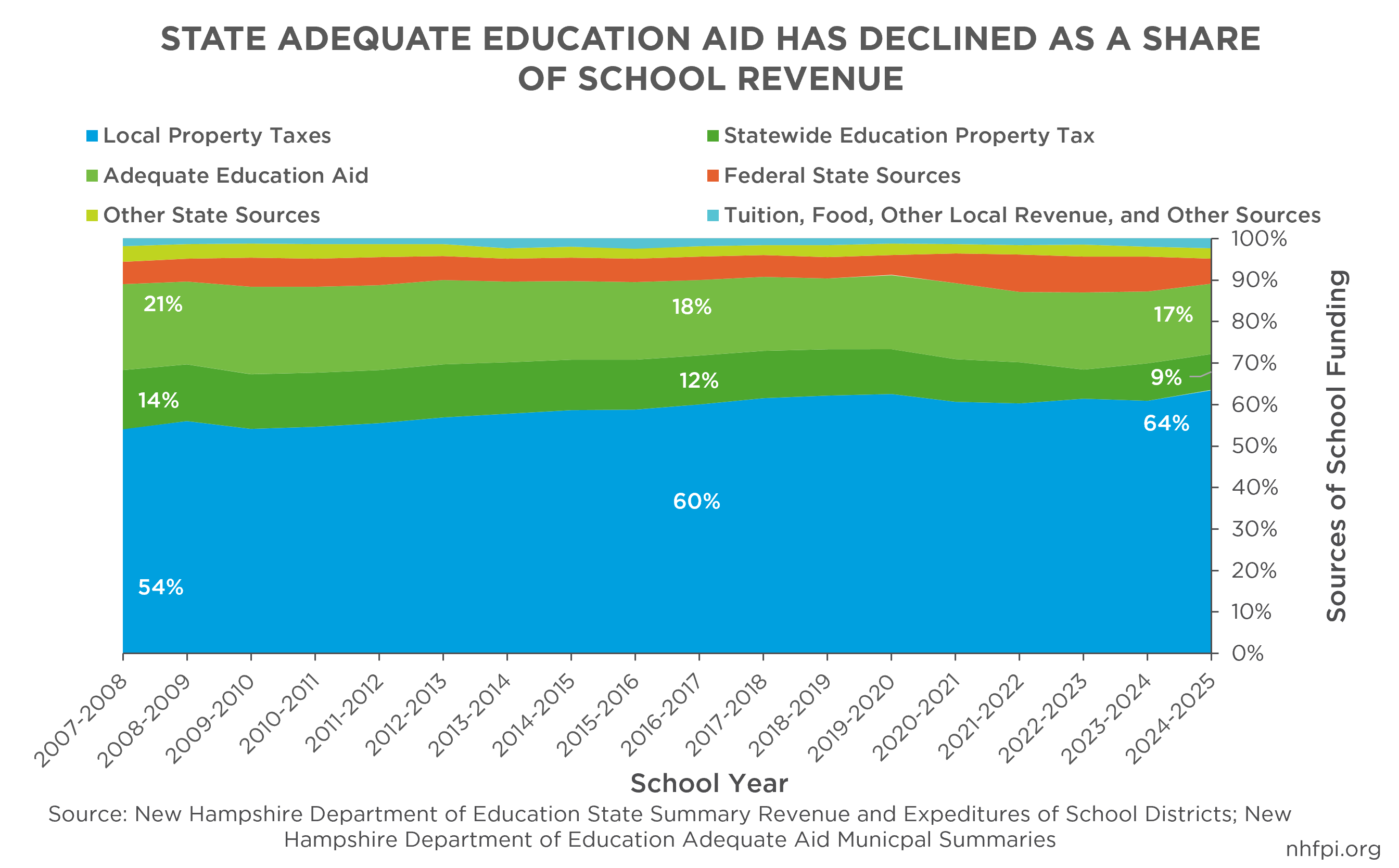
When education costs rise faster than State revenue to local governments, there is greater upward pressure on local property taxes. These costs may stem from new school investments or from increases in contracts, employee health insurance, and inflation-related expenses. Some of these costs can rise faster than overall consumer inflation or the automatic 2% annual increase included in the State’s education funding formula. For example, overall local property taxes in New Hampshire increased by 59% between 2009 and 2023 before being adjusted for inflation, while public-employer cost distributions for family health insurance plans from state and local governments increased by 73% during the same period.[19] When State support does not keep pace with these rising costs, communities often have few options other than increasing local property tax revenue.[20] Over time, total Adequate Education Aid has become a smaller share of school revenue, while local property taxes have become a larger share.
Conclusion
New Hampshire’s Adequate Education Aid formula combines two related but distinct fiscal mechanisms. The base and differentiated aid components of the formula measure student counts and student need, while three types of aid based on community characteristics provide assistance calculated in part on taxable property wealth and historical appropriations. SWEPT, a State tax that raises and retains revenue locally, offsets the amount of funding a community receives from other State revenue sources to varying degrees, depending on the amount of money the tax raises from local properties. This structure means that State aid per pupil can reflect different underlying conditions.
In some municipalities, higher per pupil aid reflects higher concentrations of students who qualify for differentiated aid. In others, that aid reflects high property wealth, low student counts, and the retention of SWEPT revenue to offset the State’s payments from other revenue sources. Municipalities with high property wealth and relatively few students may cover the State’s full calculated total Adequate Education Aid obligations through SWEPT alone. By contrast, municipalities with larger student populations, lower property wealth per pupil, and higher concentrations of student need are more likely to require additional non-SWEPT State aid. Exploring these differences and their implications helps enhance understanding of the distribution of State education aid and the impacts of those distributions.
Endnotes
[1] For the New Hampshire Supreme Court’s rulings, see Claremont School District v. Governor, December 1997, and Contoocook Valley School District v. State of New Hampshire, July 2025.
[2] See RSA 193-E:3 and RSA 198:38.
[3] See RSA 193-E to learn more about how the State defines an adequate education and the criteria used to set the cost. Chapter 19, Laws of 2026, expanded the definition of Adequate Education Aid to include all differentiated aid, effective May 26, 2026.
[4] See RSA 198:40-a and Chapters 141:223-227, Laws of 2025on how per pupil costs are determined.
[5] Districts will receive adequacy aid for home-schooled student taking courses within their district. An ADM of 0.15 will be used for each credit a student is taking at their school. The Home Education Differentiated Aid is $4,351 per pupil. See How the Cost of an Opportunity for an Adequate Education is Determined
[6] See Chapter 19, Laws of 2026.
[7] See New Hampshire Department of Education FY 2027 Adequacy Aid Estimate.
[8] The State uses the terms “Calculated Cost of an Adequate Education”, “Cost of an Opportunity for an Adequate Education”, and “Total Calculated Cost of an Adequate Education.” These terms may be misleading because the figure represents the State’s calculated funding obligation under the education funding formula, rather than the full cost of providing an adequate education.
[9] See New Hampshire Department of Education’s State Summary Revenue and Expenditures of School Districts 2024-2025 and District Public School Adequacy SFY 2025.
[10] See RSA 76:3 and NHFPI’s May 2021 blog Statewide Education Property Tax Change Provides Less Targeted Relief to learn more about the mechanics of SWEPT.
[11] See the New Hampshire Department of Administrative Services State of New Hampshire Monthly Revenue Plan for FY 2026.
[12] See RSA 76:3 for the target amount of $363.0 million in statute.
[13] See NHFPI’s April 2026 issue brief New Hampshire’s Education Funding Transition Means Reduced Aid for 109 Communities to learn more about Extraordinary Needs Grants, Fiscal Capacity Disparity Aid, and Hold Harmless Grants.
[14] Components of the remaining difference comprises of aid raised and retained locally by communities with excess SWEPT raised beyond the amount needed to cover the cost of an adequate education as determined by the funding formula. For more information, see the New Hampshire Department of Education’s publication How State Aid Was Determined and the FY 2027 Adequacy Aid Estimate for November 15, 2025.
[15] Chapter 142, Laws of 2025 delayed the intended cap on aid for municipalities with an AMD-R over 5,000 from SFY 2027 to SFY 2028.
[16] See NHFPI’s July 2025 Report The State Budget for Fiscal Years 2026 and 2027.
[17] For more information about Hold Harmless Grants, see NHFPI’s April 10, 2026 Issue Brief New Hampshire’s Education Funding Transition Means Reduced Aid for 109 Communities.
[18] For the enabling statute for the Statewide Education Property Tax, see RSA 76:3.
[19] For more on health insurance costs, see NHFPI’s October 2025 report Affordability Eroded: Changes to the Cost of Living in New Hampshire.
[20] For more information on local property taxes, see NHFPI’s April 2026 report Property Taxes in New Hampshire: How They Work and How They Compare.