
State revenue collections in February received a final boost from the one-time Tax Amnesty Program, pushing the total revenue surplus higher while key, ongoing revenue sources offered underwhelming returns.
The New Hampshire General Fund and Education Trust Fund collected a combined $178.2 million in revenue in February, which was $46.3 million (35.1%) more than planned.
Tax Amnesty Program Ends with High Receipts
The Tax Amnesty Program allowed people and businesses with unpaid taxes to pay past-due amounts without the usual nonpayment penalties that the State typically charges, and permitted lower interest costs due to the later payments than typically would be charged. The Tax Amnesty Program generated most of the surplus for the month, but not all of it.
While January’s surplus was entirely due to collections from the 2.5-month-long Tax Amnesty Program, February’s tax amnesty receipts totaled $40.6 million above the planned amount of $0.9 million. The Program, which was established by the State Budget and ran from December 1 to February 15, was projected to generate $5.0 million for the combined General and Education Trust Funds in the Legislature’s forecasting.

Instead, the Tax Amnesty Program has erased the revenue deficit thus far in State Fiscal Year (SFY) 2026 and generated a healthy surplus, well above original expectations. This cost-saving measure for people and businesses with overdue and unpaid taxes brought in $103.8 million do during its short existence, generating nearly 21 times the amount of revenue the Legislature forecast. The updated forecast from the State in mid-January, as the Program was ongoing, also only forecast $58.0 million in total revenue collected. The February collections showed the volume of unpaid taxes, or at least those that would be subsequently paid through tax amnesty, was much higher than expected.
The previous tax amnesty program, implemented in SFY 2016, generated $19.0 million. Total revenue to the General and Education Trust Funds in SFY 2025 was 26.2% higher than in SFY 2016, unadjusted for inflation. The latest iteration of the Tax Amnesty Program brought in about 546.3% more revenue than to SFY 2016 program.
Lottery Receipts Up, but Little Luck with Video Lottery Terminals
If the Tax Amnesty Program were not generating such significant surpluses, the bright spot in State revenues would be Lottery and Gaming Commission revenues. Transfers from the Lottery Commission continued to overperform in February, generating twice as much revenue for the Education Trust Fund as was forecast for the month in the State Revenue Plan. The Lottery Commission reports that sports betting and historic horse racing generated much more revenue than anticipated in February. For the first eight months of SFY 2026, which began on July 1, Lottery and Gaming Commission revenues were $45.3 million (40.1%) above their target and $37.8 million (31.4%) ahead of this same point in SFY 2025.
Separately, video lottery terminals have been generating revenue much more slowly than anticipated. These terminals are a new revenue source for the State and were established in the current State Budget under the Lottery and Gaming Commission. However, the revenue generated is distributed differently than other Commission revenue and is listed separately in the monthly State revenue reports. The State projected about $24.8 million in revenue would be collected by the end of February, but only $5.5 million has been collected in total from video lottery terminals.
Less From the Rest
Most other major revenue sources were either slightly above or below targets, with some notable exceptions.
Revenue from the Real Estate Transfer Tax nearly matched last year’s February receipts and were $1.7 million (12.8%) ahead of planned amounts for the month, with receipts for the year about $8.5 million (5.4%) ahead of target. Changes in tax revenues are typically driven by sales of single-family houses; the State reported the number of transactions was lower than during the same period last year, but values were higher, offsetting the loss generated by fewer sales.
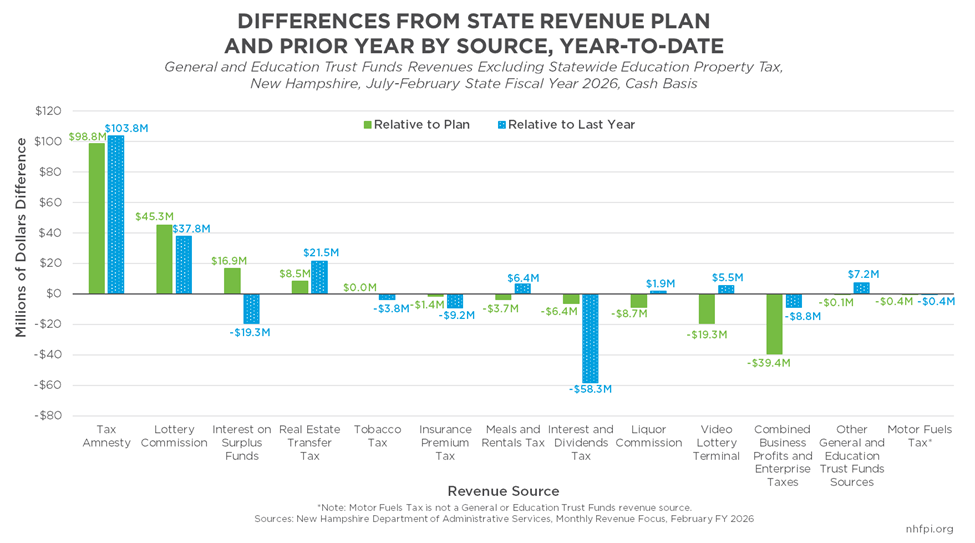
Interest on State cash holdings, which has generated about $16.9 million (47.7%) more in revenue than anticipated thus far this year, remains a declining revenue source despite the extent to which it has helped State revenue. Interest income for the year is $19.3 million lower than at the end of February last year, and the surplus it had generated year-to-date fell $3 million from the end of January to the end of February.
Revenues from the Insurance Premium Tax were below expectations, but the State reported that additional receipts will be recorded in March revenues due to the timing of payments. Insurance Premium Tax receipts have substantially helped overall State revenues in recent years as other revenue sources have declined, been lowered by policy changes, or been repealed.
Most other revenue sources delivered revenues near to their planned amounts in February. Critically, that performance includes the combined receipts from the Business Profits Tax (BPT) and the Business Enterprise Tax (BET). Receipts from these two taxes, which are very important for State revenues overall, have been uneven in recent months after a period of significant decline following years of growth early in this decade. Stabilizing business tax revenues would be a boon for State revenues generally, but are far from a certainty based on available data.
Will March and April Bring Springtime for State Revenues?
February receipts provide limited information about business tax revenues because most businesses do not owe a quarterly estimate payment or an end-of-year return in February. However, March and April include both tax returns and extension payments from the previous year and the first quarterly estimate for the new tax year for most businesses.

About 36.6% of the revenue targeted to be generated for the General and Education Trust Funds this year is expected in March and April. Anticipated receipts for these two months are the equivalent of about 74.7% of the revenue that needs to be collected to meet the State Revenue Plan total for these funds for the remainder of the year. With just over half of that target collected now, March and April receipts could be very informative as to whether the State will have a surplus or deficit this year. These data will also provide further insight into the trajectory of the key State revenue sources going into the second half of the State Budget biennium.