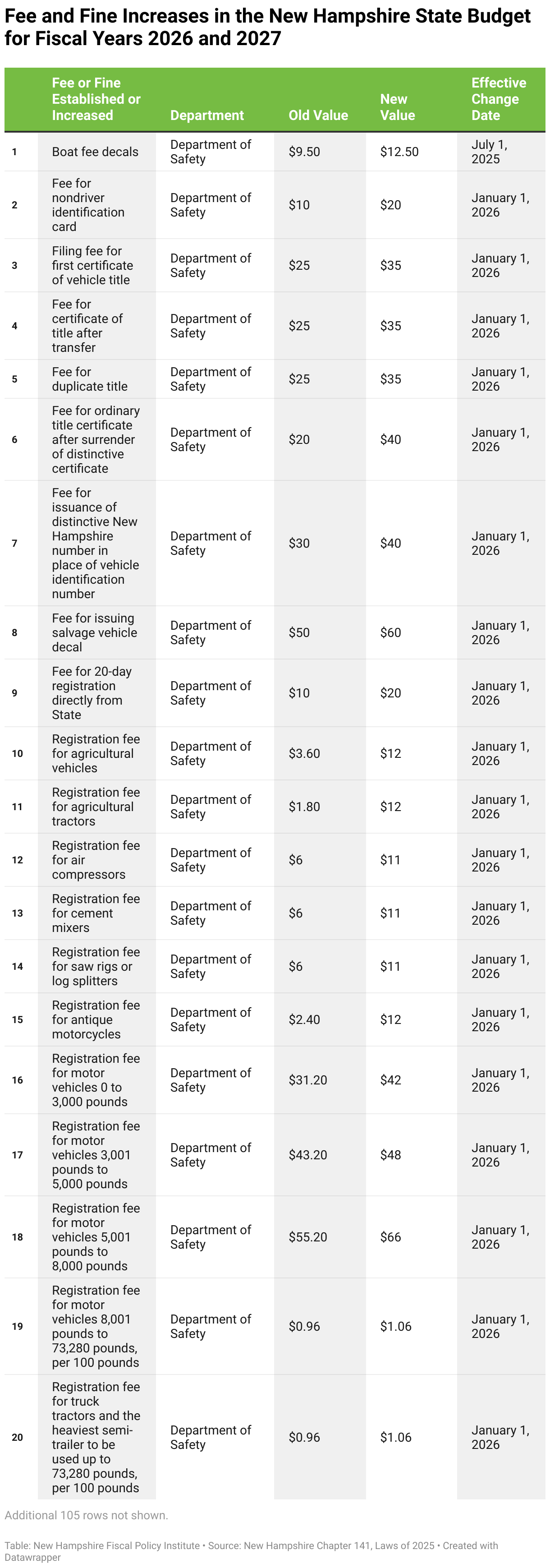
As many Granite Staters ring in the New Year, they may also find themselves reaching deeper into their wallets to pay certain State fees. Starting January 1, 2026, up to 58 new or increased State fees and fines take effect in New Hampshire, primarily for motor vehicle registrations but also potentially for accessing health services. These changes are part of a broader effort by lawmakers to help close a State Budget revenue gap, including adjustments for longstanding fee amounts for various environmental and agricultural permitting. For New Hampshire residents, these fees could mean higher out-of-pocket costs as the calendar turns over.
Facing a revenue shortfall from lower business tax revenues and the repeal of the Interest and Dividends Tax, State lawmakers either increased or established new fees and fines in 125 instances to help balance the State Budget. Many of these new fees have already taken effect, and a few are left up to State agencies to set, but about half will take effect starting January 1, 2026.
New Hampshire law requires that fees be authorized by the State Legislature in State law. The Legislature can set the dollar amounts of fees directly in law, give a State agency flexibility to set a fee within specified limits (for example, requiring that a fee be no more, or no less, than a certain amount), or authorize a State agency to establish a fee and leave the amount entirely up to the agency’s rulemaking process.
The Legislature and State agencies identified a wide variety of fines and fees, some of which had not been changed in many years and were not automatically adjusted for inflation, that they were able to adjust in State law. The Legislature voted to increase about 125 fines and fees, while eliminating two fees or portions of fees and making one of the fee increases temporary.
Which Fee Increases Were the Largest?
The Department of Safety’s purview had the largest number of fee increases, almost entirely related to motor vehicle and trailer equipment registrations. These fee increases are most likely to be directly experienced by residents, particularly residents who drive and own vehicles, and raise more money than any other collection of fee increases. These motor vehicle fee increases were projected to bring in an estimated $31.5 million more revenue into the Highway Fund during the next year and a half. Of the 56 increased fees related to motor vehicle registrations, decals, licenses, and license plates, 55 are due to take effect January 1.
The next largest increase in revenue from fees came in the form of requiring new premiums for certain Medicaid enrollees. These monthly premiums would be charged to certain Granite Advantage enrollees in the Medicaid Expansion program and to some families in the Children’s Health Insurance Program, depending on their incomes. The latter set of premiums are scheduled to start on January 1, 2026 in State law, but both sets of premiums require federal approval, and details of their implementation have not been made available yet. The federal government has added more restrictions on State flexibility to charge certain Medicaid premiums since the State Budget passed, which may complicate the State’s ability to implement these premiums. The State estimated that premiums paid by Children’s Health Insurance Program families would generate $14.3 million during the State Budget cycle, while the later implementation of Granite Advantage premiums would result in about $5.0 million in revenue generated from these fees.
What About the Other Fees?
Most other fees were projected to generate relatively small amounts of revenue. Prescription drug copayment increases were estimated to generate $750,000 per year, while the combined total of the fee increases from the Departments of Environmental Services, Fish and Game, and Agriculture, Markets, and Food would be under $10 million per year once fully implemented.
Specifically, the solid waste fees and increased fees related to dams and other waterway infrastructure was projected to raise about $1.9 million in the first year and $4.4 million in the second year of the biennium for the Department of Environmental Services. The Department of Agriculture, Markets, and Food was projected to collect about $1.8 million more per fiscal year in the State Budget, according to the Office of Legislative Budget Assistant. The Fish and Game Department was projected to raise a combined total of about $1.1 million across both years from the fee increases.
Some agencies already have authority to increase fees because the Legislature previously granted them authority to do so. While not explicitly increased by the Legislature, the Department of Military Affairs and Veterans Services included in their budget line items revenue from an increase in the fee for a Veteran’s burial service from $450 to $550.
What are the Potential Impacts of Increasing Fees?
Fees may more directly cover the administrative costs of certain government activities, such as application or plan review fees, and may function more like user fees. However, for people with relatively few resources (such as Medicaid enrollees), these fees may present a barrier to accessing services that would not exist if the cost were funded through other revenues sources. Funding more government operations with fees may also increase agency funding reliance on parts of the economy that could change quickly, such as specific activities regulated by agencies that have permitting processes.