New Hampshire families continue to face persistent and growing affordability and accessibility challenges as they navigate the early childhood education landscape. From 2017 to 2025, the average prices for child care for an infant and four-year-old in a center-based child care setting increased by 32% and 33%, respectively. For a Granite State family to enroll both their infant and four-year-old, the average price of care was about $30,000 per year in the 2022-2025 timeframe, or the equivalent of 24% of the median family income for a married couple with two or more children under age 5. This cost far exceeds the affordability benchmark of 7% of a family’s income on child care costs set by the U.S. Department of Health and Human Services.
During that same 2017-2025 period, New Hampshire saw a 14% decrease in the total number of licensed center and home-based providers, leaving families with fewer child care options and longer travel distances between providers. This decrease was driven in part by a higher closure rate amongst home-based providers, which can serve as a critical source of care for families in rural communities, those with lower incomes, or those seeking non-traditional care hours.
This rise in child care costs and decline in available providers has worsened the current affordability crisis families face when accessing high-quality child care across the state.
The New Hampshire Child Care Scholarship Program (NHCCSP) is a federal-state fiscal partnership that helps Granite State families with low and moderate incomes afford child care. The NHCCSP voucher system is uniquely situated to address both the affordability and accessibility challenges facing families. Furthermore, the NHCCSP serves as a crucial revenue stream for child care providers, who rely on the reimbursement rates granted to participating providers, to supplement their funding and maintain operations.
However, while the NHCCSP has the potential to reduce costs for both families and providers, it faces systemic constraints and barriers that limit its impact.
Scholarship Expansion Increased Enrollment, But Momentum May Be Slowing
In 2024, the NHCCSP underwent a series of significant revisions aimed at expanding access and affordability for Granite State families. These policy changes included raising the family income eligibility cap to 85% of the State Median Income, reducing family cost share contributions toward child care tuition to no more than 7% of household income for eligible families to align with federal benchmarks, and increasing reimbursement rates for providers accepting scholarships.
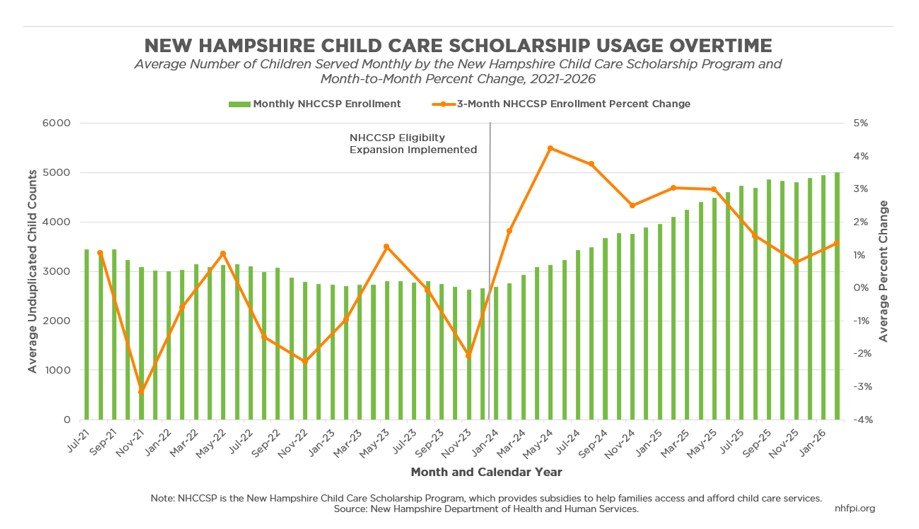
The expansion of the NHCCSP followed a steady decrease in the annual monthly average number of children enrolled in the scholarship program, which declined by 45% from 2013 to 2023. However, following the NHCCSP expansion in 2024, enrollments rates began recovering rapidly. The first six months following implementation saw a 21% increase in enrollments, increasing from 2,660 children enrolled and connected to a provider in December 2023 to 3,227 in June 2024, reaching enrollment counts not seen since 2021. By the end of 2024, the average monthly number of children enrolled in the NHCCSP and connected to a provider reached a new high of 3,884, representing a 46% increase in enrollments over a 12-month period.
While average monthly enrollments have continued to increase, the pace of enrollment growth has leveled off in recent months. The average month-over-month enrollment percent change averaged 3.23% in 2024, but declined to 1.94% in 2025, and averaged only 1.2% in the first two months of 2026.
Although there are not sufficient data to conclude whether this trend will continue through 2026, the slowing pace in enrollment increases could be symptoms of systematic constraints on the NHCCSP, and likely are not a sign of waning demand for affordable child care. Analysis conducted by the Carsey School of Public Policy at the University of New Hampshire found that, in the fall of 2024, approximately 55,000 children were potentially eligible to enroll in the NHCCSP, while an average of just 4,348 were connected and enrolled with a provider, representing about 8% of the eligible population. However, the eligible enrollment population of children does not account for whether a family is seeking NHCCSP enrollment, as some families may prefer to have other family members, friends, or neighbors provide care services.
Beyond the population of children eligible but not enrolled, 16% of the total number of children enrolled in NHCCSP in December 2025 had not yet been connected to a provider. This rate is slightly larger than the previous 11% from October 2024, per analysis of New Hampshire Department of Health and Human Services (DHHS) data from the Carsey School of Public Policy. Furthermore, the Carsey analysis found that from May 2025 to April 2026, there was an average of 553 children per month that were enrolled but not connected to a provider. The number of children who are eligible but not enrolled, as well as the number of children enrolled but not connected to a provider since the 2024 NHCCSP expansion, suggests that while the rate of enrollment growth in connected students has slowed, the need for affordable care services has remained high.
Structural Barriers May be Limiting Scholarship Program’s Potential
The gaps between the number of children enrolled in NHCCSP, the number of children enrolled and connected with a provider, and the number of children eligible but not enrolled highlight both the growing need for the NHCCSP and the systems-level supply challenges in meeting the increased demand. Additionally, the decreasing number of provider locations, largely due to the relatively higher rates of closure of home-based providers, exacerbates the supply challenges in meeting the needs of families with low and moderate-incomes that are eligible for the NHCCSP. These challenges may be particularly prevalent in communities that have historically faced greater affordability and accessibility challenges, such as families residing in rural regions of the state. These converging dynamics illuminate potential systematic financial and infrastructure challenges and constraints in the delivery of expanding access.
In the first 12 months of the NHCCSP expansion, the three-month quarterly average number of children enrolled in NHCCSP increased by 82% while the average three-month expenditures per child increased just $490, representing a 23% change. Furthermore, from SFY 2023 to 2026, NHCCSP State General Fund appropriations decreased 10%, despite a 69% enrollment increase in the NHCCSP. In the State Fiscal Years 2026-27 State Budget, 0.7% of total appropriations were for early care and education services, relative to 1.0% on the University System of New Hampshire, 2.0% on the State Department of Corrections including State prisons, and 7.6% on payments to nursing facilities and in-home care for older adults and adults with physical disabilities. To meet these key supports following the expansion of the NHCCSP during the second half of 2025, the State began tapping into available Temporary Assistance for Needy Families (TANF) backstop funds to supplement the fiscal shortfalls and maintain current delivery of services. More specifically, these TANF dollars were utilized to ensure that the NHCCSP does not reach the point of a funding bottleneck that results in a waitlist. The State has not experienced a waitlist for NHCCSP since State Fiscal Year 2011. However, only 30% of TANF funds may be used to bolster NHCCSP under federal rules, and separate State decisions on the use of these funds further limits that amount to just 20%.

As the DHHS has expressed concern about whether existing appropriations can sustain NHCCSP support for families through the remainder of the State Budget biennium, the program’s continued reliance on TANF funding poses additional fiscal uncertainty. If TANF dollars are insufficient to cover costs not supported by other appropriations, additional State General Funds may be necessary to prevent future waitlists. A lack of funding could generate concerns for both enrolled families who are not connected to a provider as well as families who are eligible but not enrolled as a result of an inadequate supply of child care. Furthermore, the uncertainty around the reliability of NHCCSP funding could disincentivize provider participation.
Sustainable State investment strategies could minimize these potential barriers and could guarantee and expand financial incentives for provider participation. These funding strategies could also bolster initiatives that support retaining and recruiting qualified early childhood educators and staff to help ensure the delivery of high-quality care. From 2023 to 2025, the New Hampshire child care workforce decreased 6%, representing a loss of 330 early childhood staff and educators. Not only are qualified staff critical for providing high-quality care delivery services, but they are also essential for meeting the heightened need for expanding provider capacity.
Funding barriers affect both the ability of providers to meet the increased demand for affordable care services through the NHCCSP, as well as the systems-level infrastructure to support the outreach and communication to both providers and families. Analysis conducted by the Carsey School of Public Policy found that nearly half of families surveyed had never heard of the NHCCSP. The report also highlighted families experiencing enrollment challenges related to administrative burden, such as paperwork and complicated application processes. Some families may also face additional difficulties connecting with and accessing relevant State supports and resources due to a lack of transportation, social stigma, language barriers, literacy challenges, or work schedule conflicts. However, beginning in 2026, the State implemented a pilot presumptive eligibility program framework for the NHCSSP that could mitigate some of the administrative burden hurdles to families. Although strengthened, targeted outreach strategies could further relieve this barrier to information and expand the reach to additional eligible families.
Providers are also facing similar challenges as families. Research has found that the administrative burden associated with provider participation in child care subsidy programs, such as the NHCSSP, can further stress providers’ already limited capacity. These stressors are heightened for providers with less staff and resource capacity, such as home-based providers.
Additionally, despite increased reimbursement rates for providers following the NHCCSP expansion, providers continue to experience disparate fiscal challenges. About one in five licensed providers do not participate in the NHCCSP. As a result of the fragile economics of operating a child care facility, navigating high operating costs and low compensation, the NHCCSP can serve as a critical source of revenue for providers, but may still fall short in meeting increasing provider financial needs. Consequently, many providers are faced with the difficult decision to pass on costs to families through co-payments when the amount that provider’s charge families enrolled in NHCCSP is greater than the DHHS standard weekly maximum reimbursement rate.
Raising these reimbursement rates could provide much needed financial relief for providers and support participation in the NHCCSP. Alternatively, the State could implement a cost estimation model in lieu of the current market rate survey, which could be used to set provider reimbursement rates that would account for broader financial variables that providers face, such as staff wages, benefits, facility costs, training, and other costs. Accounting for these additional provider costs could offer a more accurate and complete cost of providing care to families.
Future Considerations
Although reevaluating and expanding the NHCCSP provider reimbursement rates is necessary for supporting provider fiscal challenges, those efforts likely would still not be enough to adequately address the larger supply constraints facing the State. A holistic and multi-faceted funding and care delivery approach that accounts for both the diverse and varied needs of providers and families, including strategies beyond the NHCCSP that strengthen the broader New Hampshire early care and education landscape, could help alleviate the severe constraints on child care access and affordability. To meet this systems-level evaluation and increased investment, some states have established dedicated funding streams for early childhood education initiatives. Such funding streams can reduce the risk of running out of funding, strengthen current resources, and expand supports for affordability and accessibility while maintaining a high quality of care for children and families.